Unknown number calling: should you call back?
One ring, a withheld number, an unfamiliar foreign prefix: should you call back, can the caller be identified, and what are the real Belgian options.
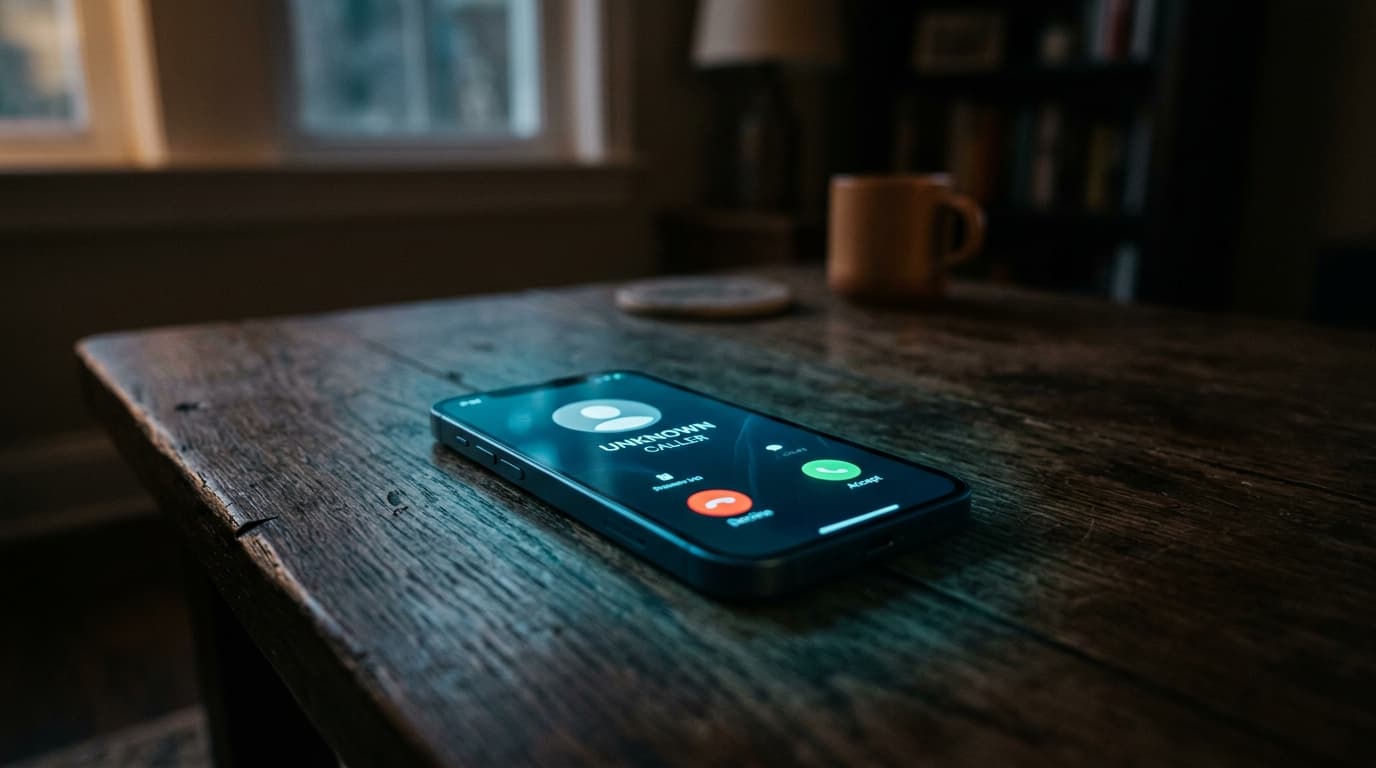
No, do not call back an unknown number that only rang once. It is almost always a trap. A withheld number, by contrast, cannot be identified by an app or a clever trick: it takes a formal complaint, and a specific body to handle it.
An unknown number is almost never aimed at you personally
A phone showing a number you do not recognise triggers a reaction out of proportion with what is actually happening. Most of the time it is neither a relative in trouble nor a stranger targeting you. It is an automated system dialling thousands of numbers in a row, Belgian or foreign, with no idea who will pick up.
That mechanism changes everything about the right response. It explains why the correct reflex depends less on who you are than on how the call behaved: its length, its origin, what it leaves behind. Three families of cases keep coming up in Belgian reports: the single-ring call that pushes you to call back, the withheld number that reveals nothing on its own, and the unfamiliar foreign prefix that never calls twice.
A typical Belgian household complicates things further. The landline on the bundle, the two parents' mobile lines at two different operators, and the teenager's prepaid card do not share the same spam filter or the same app. The Proximus app, Telenet's, or Orange's may flag a number as suspicious on one line and stay silent on the line next to it, simply because each operator feeds its own reporting database. Checking a single app therefore only protects part of the household.
Should you call back an unknown number that rang once?
No, unless you are specifically expecting a call of that kind.
The explanation fits in one sentence published by the Federal Police on 15 May 2025: scammers launch dozens of simultaneous calls from an automated system, each cut off after one or two rings. Enough recipients call back out of reflex or politeness, and land on a premium-rate number designed to keep the line open as long as possible. The name of this fraud, wangiri, comes from Japanese and literally means "one ring and cut".
A genuine call behaves differently. A courier, a doctor or a school gives you time to pick up, or leaves a message. A single ring followed by silence is never a technical accident.
Can a withheld number be identified?
Not by you. That is the answer that disappoints most people, and it deserves to be stated plainly.
Belgian operators keep the identity of whoever withholds their number in their call logs. They never disclose it spontaneously to the person who was called, whatever app is installed on the phone. The only legal route runs through a malicious-calls complaint filed with the Telecommunications Ombudsman Service, which can then ask the operator to identify the holder, with a view to a police complaint if the facts warrant one. It is an administrative, documented process, not an app to download. That built-in slowness is not a flaw: it stops mere annoyance from opening up the full identity of any caller, which stays protected until a documented file exists.
Six situations, six sensible responses
How the call behaves matters more than the number itself.
| Behaviour of the call | Signal to notice | Should you call back | What to do |
|---|---|---|---|
| Number saved in your contacts | Normal ring, name displayed | Yes | Nothing special |
| Unknown Belgian number, several rings, message left | You can judge before acting | Depends on the message | Verify the claimed identity through an independent channel before calling back |
| Unknown Belgian number, one ring, no message | Typical wangiri signature | No | Block the number, do not dial it |
| Withheld or "private" number | No identification possible by yourself | Case by case | Log the date and time; file a malicious-calls complaint if it repeats |
| Unusual foreign prefix (+225, +216, +371, among others) | Classic opening move of a callback scam | No | Check the prefix, block it, do not call back |
| A text arrives right after, suggesting another number to dial | Associated SMS fraud (smishing) | No | Do not dial that second number; forward the text to suspect@safeonweb.be |
Table built on 26 September 2026 from the recommendations of the Federal Police, the BIPT/IBPT and Safeonweb.
Why can a single-ring call end up costing money?
Because the number that rings is never, technically, the one you end up paying. It is a foreign premium-rate line billing by the minute from the moment the call connects. Orange Belgium describes two variants on its dedicated support page: the missed call from an unfamiliar foreign prefix, and the text message promising a prize that invites you to dial a number abroad. Neither page we checked, not Orange's nor the Federal Police's, publishes a precise amount for Belgium; the mechanism itself, though, is documented without ambiguity on both sides.
The trap to avoid fits in one line: a call that lasts one second has nothing to tell you. It is only waiting for you to call it back.
The BIPT/IBPT took a year to change its mind on spoofed numbers
On 30 May 2026, the Belgian government approved a measure letting a company register its customer-service number on a so-called do-not-originate list, managed by the BIPT/IBPT, the Belgian telecom regulator. A number on that list can never be used to place a call: if a fraudster tries to spoof its caller ID to pose as a bank or an insurer, Belgian operators block the call before it ever arrives.
The detail worth knowing is that the regulator itself had dismissed this mechanism a year earlier, calling it of limited use. Cases of identity-spoofing fraud targeting bank and insurance customers weighed heavily in that reversal, driven by ministers Vanessa Matz and Rob Beenders.
One limit is stated plainly in the scheme: it protects customer-service numbers a company registers voluntarily, never a personal mobile number, and never a text message.
Free blocking of a number, though, remains available to every subscriber, and its exact shape depends on which network carries your line. Proximus (its own copper, fibre and mobile networks), Orange (its own mobile network, plus the Walloon cable network inherited from VOO) and Telenet, whose network also carries BASE's SIM cards, each offer blocking on request from customer service, and none of them ever discloses the identity behind a blocked number. Here, checked on the same day, is what each Belgian point of contact actually does and does not do.
| Point of contact | Room to act on an unknown number | Clear limit |
|---|---|---|
| Your operator | Blocks the number on your line, free of charge | Never discloses the holder's identity |
| BIPT/IBPT, do-not-originate list (since 30/05/2026) | Blocks calls spoofing a registered customer-service number | Covers neither personal mobile numbers nor text messages |
| Telecommunications Ombudsman Service | On a malicious-calls complaint, asks the operator for the holder's identity | Does not act without a formal, documented complaint |
| Safeonweb | Analyses a suspicious text forwarded to suspect@safeonweb.be | Does not handle voice calls |
| Local police | Takes a report of telephone harassment | Does not identify the number itself; refers to the telecom ombudsman |
Overview built on 26 September 2026 from each body's own official pages.
What should you do if you already called back a suspicious number?
Hang up as soon as you hear hold music, a long silence, or a voice trying to keep you on the line. Above all, do not dial a second number suggested by text afterwards: that is often the most expensive part of the scheme.
Then watch your bill rather than your balance today. At most Belgian operators, a call to a foreign premium-rate number only shows up on the following statement, not in real time on a usage-tracking app. If the amount exceeds what an ordinary call of the same length would have cost, dispute the line in writing with your operator, quoting the exact date and time.
Five signals worth noticing before you even pick up
- The number shown starts with a prefix no one in the household normally uses.
- A single ring cut dead: no genuine service hangs up that fast.
- A text arrives right after the missed call, proposing a different number to dial.
- The name displayed matches no saved contact, on a line that is rarely given out.
- The same number rings back several times in one day, at different hours: a sign of a machine, not a person.
One point worth adding before closing. Ordinary commercial cold-calling, from companies that follow the law, is handled through a completely different channel: free registration on the "Do Not Call Me" list, covered in our guide on blocking cold calls from a landline. That is not the subject here. A wangiri call or a withheld number are fraud, not marketing, and the list never stops either.
For more on a caller's identity, our guide on which operator owns a Belgian number explains what a prefix still tells you today. The real cost of calling back a Belgian premium-rate number is set out in premium-rate numbers in Belgium, and blocking cold calls from a landline in cordless landline phones: which one blocks cold calls. To understand how a Belgian number looks from abroad, see Belgium's country code. And if the question is about the subscription rather than the call, our mobile operator ranking is the place to start.
Sources: Federal Police (wangiri scam, 15 May 2025), BIPT/IBPT (do-not-originate list, approved 30 May 2026), L'Avenir (coverage of the measure, 30 May 2026), Telecommunications Ombudsman Service (malicious-calls complaint), Safeonweb, Centre for Cybersecurity Belgium (reporting suspicious texts), Orange Belgium (support page on missed-call fraud).
Frequently asked questions
Maxime suit le marché télécom belge depuis dix ans. Il épluche les grilles tarifaires de Proximus, Orange, Telenet, VOO, BASE et des MVNO pour traduire le jargon (VDSL, câble, Easy Switch, 4play) en conseils utilisables.