Wi-Fi calling: free in Belgium, unclear beyond it
Wi-Fi calling and VoLTE in Belgium are free and billed as call minutes on all four networks, yet five Belgian sources disagree on whether they work abroad.
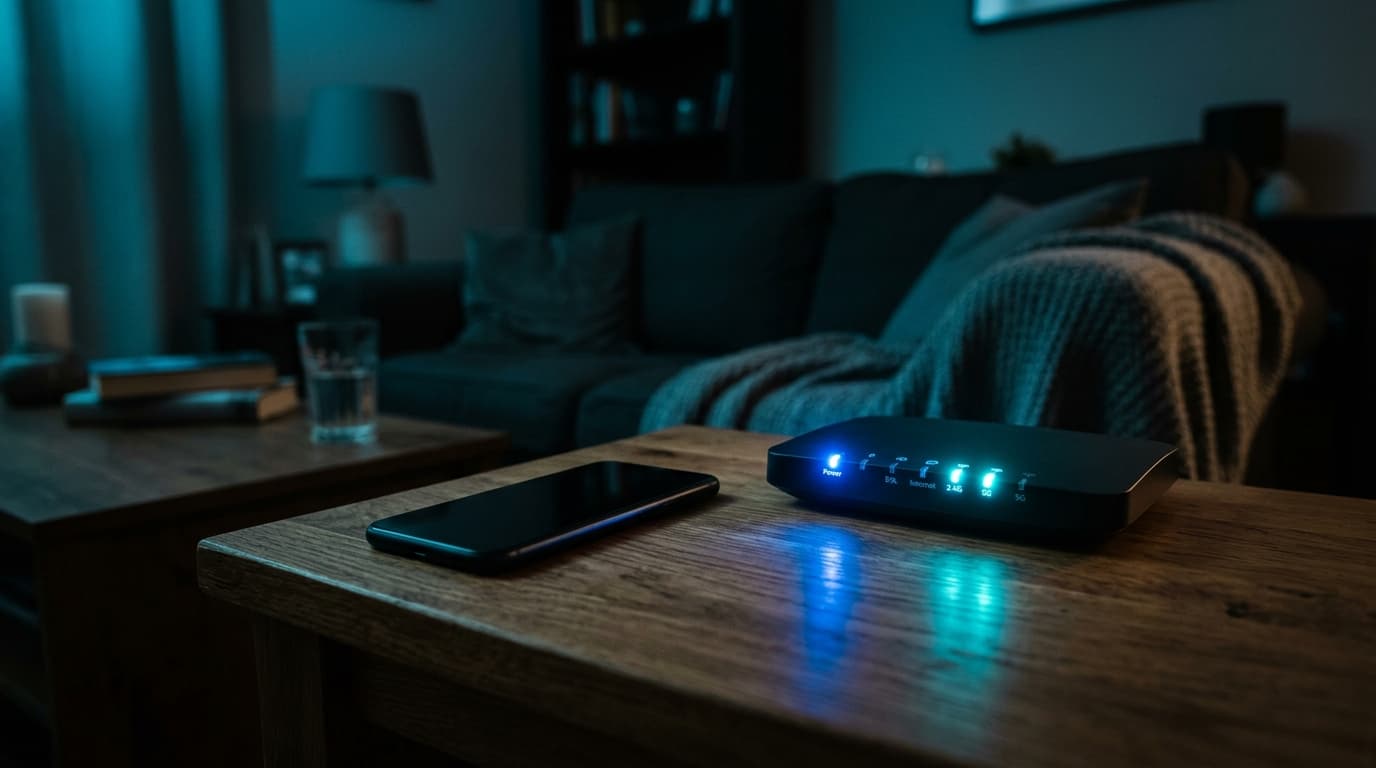
Wi-Fi calling sends your mobile calls through your router instead of through a mast. On all four Belgian networks it is free and billed as call minutes, exactly like an ordinary call. Outside Belgium, operators do not give the same answer: five Belgian sources, three different answers, surveyed on 19 September 2026.
Wi-Fi calling, which operators also label VoWiFi for Voice over Wi-Fi, is an ordinary phone call carried over a Wi-Fi connection instead of a mobile antenna. Nothing to install, no app: your SIM card and your usual number do the work. Its twin, VoLTE for Voice over LTE, does the same thing over 4G or 5G.
Wi-Fi calling, VoLTE and calling apps are three different things
Three technologies carry calls on that handset, and only two of them run through your operator. The word « Wi-Fi » in « Wi-Fi calling » describes the pipe, not the company providing the call.
The distinction drives the bill. A Wi-Fi call or a VoLTE call starts from your SIM card: it goes out with your Belgian number, it rings anyone, and it is counted in call minutes. A WhatsApp, Messenger or FaceTime call starts from an app: it only reaches people running the same app, and it is counted in data as soon as you leave Wi-Fi. Telenet takes the trouble to separate the two cases on its help page, and it is one of the few Belgian operators to do so that plainly.
| The term | Where the call travels | Billed against | Where it works |
|---|---|---|---|
| VoLTE, or 4G calling | your operator's 4G or 5G network | your call minutes | anywhere 4G reaches |
| VoWiFi, or Wi-Fi calling | any Wi-Fi network, but through your operator | your call minutes | in Belgium; beyond that, answers vary |
| App-based call | the internet, without your mobile operator | your mobile data, unless on Wi-Fi | anywhere there is a connection |
| Plain 2G call | the 2G network | your call minutes | anywhere 2G reaches, with no simultaneous browsing |
Surveyed on 19 September 2026 on the help pages of Proximus, Orange and Telenet.
A second and even more stubborn misconception: Wi-Fi calling does not eat your data allowance. Orange states in writing that calls over its 4G network do not use the mobile data bundle, and the rule holds for Wi-Fi too. It does consume bandwidth on the internet line you are sitting on. At home, that means your bundle.
The BIPT, the Belgian telecoms regulator, describes the feature in the same terms, presenting it as a way to make calls and send texts without a mobile signal, over the fixed internet line.
A third confusion, and this one costs money. A Wi-Fi call to a foreign number is not a free internet call: Proximus writes that such calls are billed exactly like calls abroad made over the mobile network, and that texts sent over Wi-Fi count as mobile texts. A household hoping to reach a relative living outside Belgium for free by going through its router has picked the wrong technology: there, the free route is an app-based call, or the international option on the bundle's landline.
Which Belgian operators offer Wi-Fi calling, and on which network?
All four Belgian networks offer it, along with most of the brands hosted on them. The table below crosses the operator, its host network and what each one publishes on its own site.
| Operator | Host network | Wi-Fi calling | Included on | Outside Belgium, per the source |
|---|---|---|---|---|
| Proximus | own fixed and mobile networks | yes | plans and prepaid cards | « everywhere in Belgium », nothing published on abroad |
| Orange | own mobile network | yes | all price plans and Tempo cards | its help page says « only in Belgium », its blog says « and elsewhere » |
| Telenet | own mobile network, cable in Flanders and Brussels | yes | all mobile subscriptions | not published |
| BASE | Telenet group, Telenet network | yes | mobile subscriptions | not published |
| Mobile Vikings | Proximus group, Proximus network | yes | not published | not published |
| Scarlet | Proximus group, Proximus network | yes | not published | not published |
| hey! | Orange brand, Orange network | yes | not published | not published |
| yoin | MVNO on the Proximus network | yes | all subscriptions | « yes », according to its own blog |
| Lycamobile, Mega, Zuny | hosted on Belgian networks | not listed as compatible | not published | not published |
Surveyed on 19 September 2026 on the operators' websites, supplemented by the Astel dossier of 21 August 2024 for brands that publish nothing. « Not published » means the operator does not put that information online, not that the answer is no.
One caveat on the last row, because it ages quickly. The Astel survey dates from August 2024 and listed VOO among the incompatible brands; VOO mobile has since been absorbed by Orange, which makes the entry moot. We found no official page at Lycamobile, Mega or Zuny confirming or denying compatibility in September 2026.
The « host network » column is not decoration. A Wi-Fi call does not stop at your router: it travels up to the core network of the operator hosting you. A Mobile Vikings or Scarlet line therefore runs its Wi-Fi calls through the Proximus infrastructure, a hey! line through Orange's, a BASE line through Telenet's. When an alternative brand announces Wi-Fi calling, the host network is what supplies it, and the host network is also what sets the rules abroad.
On prepaid, by contrast, Orange is explicit: its Tempo cards give access to Wi-Fi calling on the same footing as subscriptions. Rare, and rarely said.
A 4G handset is not necessarily a VoLTE handset
This is the trap to avoid, and the operator spells it out. Telenet warns that on some 4G devices you browse over 4G but still place calls over 3G. With 3G gone, those handsets fall back to 2G, with no simultaneous browsing.
Does Wi-Fi calling work abroad?
Belgian sources do not agree, and two of them belong to the same operator. Here is the raw result of the 19 September 2026 survey, with no arbitration on our part.
The Orange help page on poor reception at home states that Wi-Fi calls are currently possible only in Belgium. The Orange blog, in a piece dated 19 March 2024 and still online, says exactly the opposite: you call from anywhere in Belgium « and elsewhere », even without a 2G, 3G or 4G signal. Proximus frames its announcement as « everywhere in Belgium where wi-fi is available » and says nothing about abroad, while noting that VoWiFi calls to foreign numbers are billed exactly as calls made over the mobile network. The comparison site Astel states that the feature does not work outside the country, for security reasons, and points out that a VPN with a foreign IP address is enough to break it. The blog of yoin, an operator hosted on the Proximus network, answers « yes » in its own FAQ.
Three answers, then, to a question that is anything but exotic: it comes up the moment a member of the household leaves to work, study or live a few months outside Belgium.
That same Orange blog article gives away its age another way. It lists the eligible plans, Koala, Dauphin, Panthère, Aigle and their Smartphone variants, none of which are in the operator's current catalogue, while its help page simply says « all our price plans ». Two pages on the same site, two scopes, never reconciled.
The distinction missing everywhere, and the one that probably explains the disagreement, fits in a sentence: Wi-Fi calling remains an operator service, subject to roaming agreements and to the national rules of the country you are standing in, where a WhatsApp call depends only on a connection. Before you travel, the only reliable answer is your operator's, in writing, for your specific plan.
Your internet provider can break your mobile operator's Wi-Fi calling
Here is the genuinely awkward part for a household holding several contracts. Wi-Fi calling puts the family's mobile brick on top of its internet brick, and the two do not necessarily come from the same supplier.
Astel observes that some Belgian connections behave erratically with VoWiFi, naming VOO, Zuny and edpnet. The mechanism is mundane: a Wi-Fi call travels through an encrypted tunnel to the mobile operator's core network, and anything filtering that traffic on the fixed line, a corporate router, a firewall, a VPN, a hotel network, can cut it off. Your mobile operator says everything is fine, your internet provider says the same, and the phone stays silent.
The typical case is a household whose contracts piled up over the years: internet and television at one operator, two mobile lines at a second, the teenager's prepaid line at a third. The living room Wi-Fi is one single network, yet each of the three lines has to get Wi-Fi calling from its own operator. One of them does not offer it, and that is the person who keeps walking into the garden to make a call, while nothing at all is broken for the others.
Hence the advice, repeated by comparison sites, to take mobile and internet from the same operator. Technically it holds up. Financially it does not always, and we have put numbers on that trade-off elsewhere, in our comparison of internet and mobile with the same provider or separately.
One side effect goes unadvertised. A house with no mobile coverage that calls over Wi-Fi loses its calls at the same moment as its connection: a cable fault, a power cut, a modem rebooted by the technician. The day the internet goes, the bundle's landline goes too, and the mobile with it. Our advice on handling an internet or TV outage then applies to all three bricks at once.
Does 112 go through over Wi-Fi?
In principle yes, and the legal nuance deserves to be stated properly, because it is almost always garbled.
The BIPT, the Belgian telecoms regulator, points out that your operator must let you call 100, 101 and 112 free of charge and must make sure your location reaches the emergency services. Its warning about emergency numbers targets nomadic internet telephony services, the Skype kind, whose number follows the user anywhere in the world. A Wi-Fi call does not fall into that category: it starts from your SIM card, at your Belgian mobile operator, who remains bound by that obligation.
The yoin blog still adds a qualification, writing that emergency calls are not always possible over Wi-Fi. So keep one reflex in mind: if mobile coverage at your address is nil and the router has just gone down, nothing goes out, neither 112 nor anything else. Our survey of the cost and reachability of Belgian emergency numbers and short numbers covers the rest.
Mobile repeaters are illegal, Wi-Fi calling is the official workaround
On this point the regulator decides for itself, and it recommends Wi-Fi calling ahead of anything else.
The BIPT tells private customers with reception problems to use VoWiFi as an alternative. And it is categorical about the other route: the amplifiers sold online under names such as « signal booster » or « GSM repeater » use frequencies assigned to the operators, cannot be switched on without the consent of every operator being amplified, and the BIPT has the means to locate and seize illegal repeaters. If you have activated one, the instruction is to take it out of service immediately.
Wi-Fi amplifiers, on the other hand, are allowed without conditions: they do not touch operator frequencies. Renting or buying one is a separate question, which we covered in our guide on the Wi-Fi extender rented from your provider or bought outright.
Five things to settle before you phone customer service:
- Wi-Fi calling is switched on in the phone's settings, not at the operator; none of the four Belgian networks asks you to subscribe to anything;
- the handset must be up to date, Orange requiring at least iOS 11.3 and the latest maintenance release on Android;
- the switchover is not instant, a few minutes on a Samsung, sometimes a few hours on an iPhone;
- on Android a VoWiFi logo appears at the top of the screen when the feature is live, while iPhones do not always show an icon;
- if nothing changes after several days, have the subscription checked rather than the device.
3G has gone, 2G will follow
That leaves the calendar, because it explains why these two acronyms moved out of technical documentation and into your phone settings.
| Network | 3G switched off | 2G |
|---|---|---|
| Telenet and BASE | September 2024, as announced by Telenet | « a few more years », no date published |
| Proximus | from late December 2024 | no date published |
| Orange | zone by zone, from January 2024 through 2025 | kept at least until 2028 |
Dates announced by the operators themselves. The Telenet help page consulted on 19 September 2026 still refers to September 2024 in the future tense.
Without 3G, a handset that cannot do VoLTE places calls over 2G, at lower quality and with no simultaneous browsing. Orange adds a detail households forget: an old mini or micro SIM card can block access to 4G and needs replacing. To pick the right line for each member of the family, our guide on which mobile operator to choose in Belgium starts from actual coverage at the address, and our mobile ranking uses the same host networks as the table above.
Frequently asked questions
Maxime suit le marché télécom belge depuis dix ans. Il épluche les grilles tarifaires de Proximus, Orange, Telenet, VOO, BASE et des MVNO pour traduire le jargon (VDSL, câble, Easy Switch, 4play) en conseils utilisables.