PUK code lost: where to find it, operator by operator
PUK code lost, SIM card locked: where to find it at Proximus, Orange, Telenet, BASE and five other Belgian operators, and how many attempts you have left.
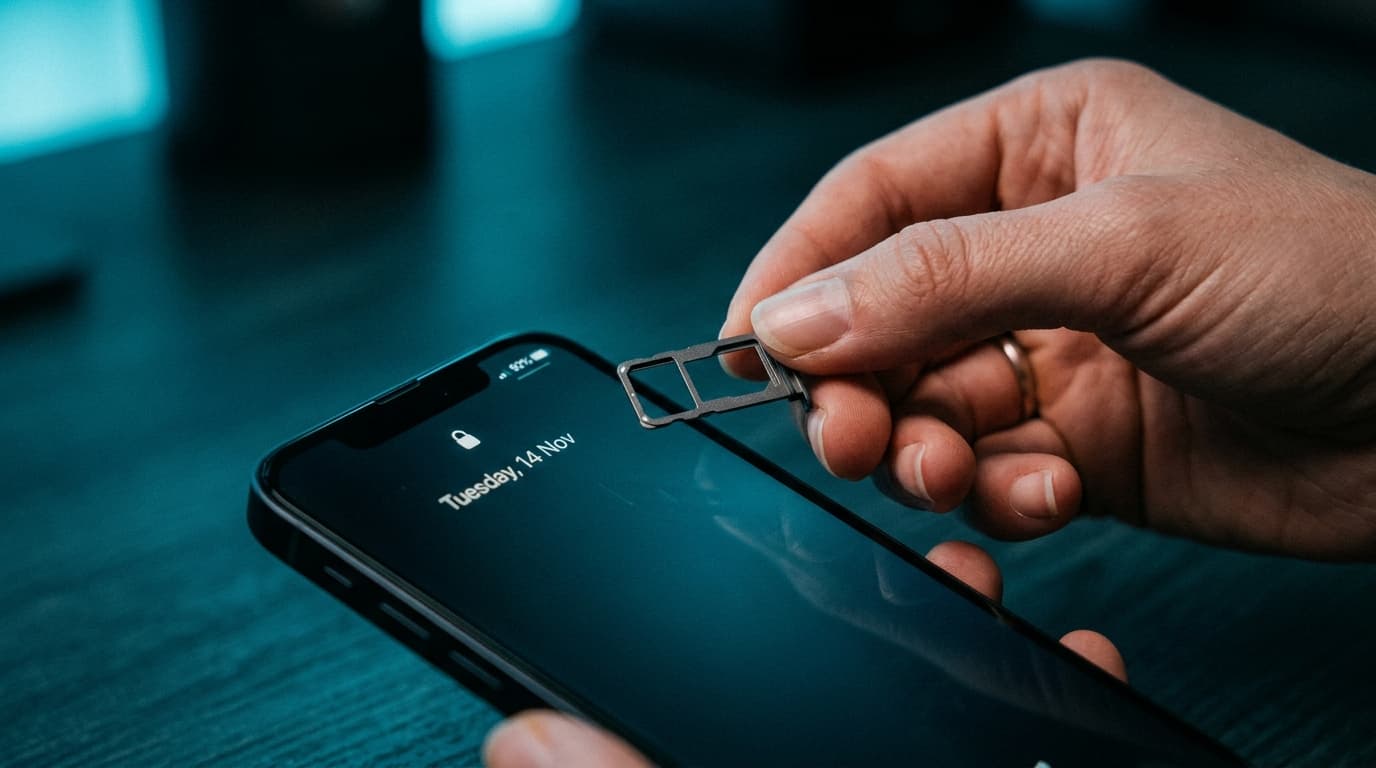
The eight-digit PUK code is printed first of all on the plastic holder of your SIM card, then available in your customer account area. At most Belgian operators you can retrieve it yourself, in three clicks. Here is where it hides at each of them, and how many attempts you have left before the card is fit for the bin.
The PUK code, short for personal unblocking key, is an eight-digit key generated by the operator when the SIM card is manufactured. It cannot be changed, it cannot be guessed, and it belongs to the card rather than to the number. Its only job is to give you back control of a SIM card locked after three wrong PIN entries.
What exactly is a PUK code?
A backup key specific to one SIM card. The PIN code protects everyday use of the line, the PUK steps in once that PIN has been typed wrong three times in a row and the phone shows « SIM locked ». The personal unblocking key follows the same logic everywhere in the world.
Two details save costly mistakes. The first concerns the two codes printed on some holders: only PUK1 unlocks the card. PUK2 serves the PIN2 code, which drives side functions such as call restriction, and it will never get you past a lock screen. Mobile Vikings, hosted on the Proximus network, takes the trouble to say so in its help pages.
The second: the PUK follows the card, not the line. Replace the SIM card, move to an eSIM, switch operator through number portability, and you inherit a new code.
Where can you find your PUK code at each Belgian operator?
On the plastic holder of the original SIM card, if you kept it. Otherwise in the customer area, with three exceptions. Here is the survey of 2 September 2026, support page by support page.
| Operator | Host network | Where the PUK code sits | Fallback channel | Cost of that channel |
|---|---|---|---|---|
| Proximus | own fixed and mobile networks | SIM card holder, MyProximus web and app | contact form, customer number required | free; line blocking on 0800 33 800 |
| Orange | own mobile network | holder or welcome letter, customer area under « My devices » | 5000, options 4 then 1 | free |
| Telenet | own mobile network, cable in Flanders and Brussels | email, letter or SMS depending on activation, and MyTelenet | 015 line, number differs between sources | national rate for a geographic number |
| BASE | Telenet group, Telenet network | card packaging, My BASE web and app | 1999 from a BASE line, 0486 19 19 99 otherwise | call to a mobile number |
| Mobile Vikings | Proximus group, Proximus network | customer area, SIM card settings, PUK1 code | 1976 from a Mobile Vikings line | free from the network |
| Scarlet | Proximus group, Proximus network | card holder, confirmation letter, contact form | 0800 84 000 | free |
| hey! | Orange brand, Orange network | card holder or welcome letter, My hey! under « PUK Code » | chat and WhatsApp, 8am to 10pm | free, no phone line published |
| DIGI | own network plus Proximus roaming | SIM card holder, no other documented channel | not published | not published |
| yoin, formerly Youfone | MVNO on the Proximus network | card holder and accompanying letter | 1988 for customers, otherwise 078 48 61 11 | 1988 free, 078 is a shared-cost number |
Surveyed on 2 September 2026 on the operators' official support pages. « Not published » means the operator does not put that information online.
Three things stand out. DIGI, which runs its own network with Proximus roaming, offers a single sentence: the code is on the card holder, full stop. hey!, the low-cost brand of Orange running on the Orange network, warns that it can retrieve your PUK but not a PIN code you customised yourself. And on Telenet, Belgian sources do not even agree on the number to dial: police.be publishes 015 666 655, the comparison site CallMePower publishes 015 66 66 66. We have not settled that one, so use MyTelenet instead.
How many attempts before the SIM card dies?
Thirteen. Three wrong PIN codes lock the card, ten wrong PUK codes destroy it. BASE then shows « SIM card rejected » and writes that the card is no longer usable; Orange announces the same ten-attempt limit. You have to buy a new one. Telenet and yoin publish the price: 5 € each, surveyed on 2 September 2026, outside any promotion.
Can you unlock a SIM card without the PUK code?
No. No manipulation, no factory code, no restart replaces the PUK, and the sites promising to « calculate » it from the IMEI or from the card serial number are answering the wrong question: those numbers identify the device and the card, they do not contain the key.
The operator does have it. Six of the nine operators surveyed let the code appear directly in the customer area, without going through anyone and without waiting for a call centre.
The bad reflex is to try the PIN again just in case. Every failed attempt moves the card closer to the bin.
Who in the household can retrieve the PUK code of a bundled line?
The account holder, and nobody else. That is the friction point as soon as several lines live under one contract.
On a family bundle with three or four SIM cards, the line that locks is rarely the account holder's. It is the teenager's, after they changed their PIN code, the elderly parent's, after they forgot it, the tablet's, unused for six months. Yet the PUK appears in the customer area of the subscription, not on the locked handset: you therefore need the account holder's password, or their phone call. Proximus goes further and asks for the customer number printed on the single bundled invoice before issuing a code through its form.
Add to this that the words « PIN code » cover four different things in an equipped home: the mobile SIM card, the TV set-top box and its parental control, the bank card, the identity card. The confusion runs so deep that the municipalities of Nivelles, Forest and Schaerbeek all three publish, on their official websites, a page titled « Loss of PIN and PUK codes » that says nothing about mobile telephony and everything about the Belgian electronic identity card, the eID.
PIN, PUK, ICCID, IMEI: which number does what?
Five numbers circulate around a mobile line, and only two of them are secret codes. The table below separates what unlocks from what identifies.
| The number | Digits | What it does | Where to read it | If it is lost |
|---|---|---|---|---|
| SIM card PIN code | 4 to 8 | authorise use of the card in the phone | card holder, or original code in the customer area | three errors and you need the PUK |
| PUK code, or PUK1 | 8 | unlock the card after three PIN errors | card holder, customer area, customer service | ten errors and the card must be replaced |
| PUK2 code | 8 | unblock the PIN2 code and its side functions | same holder | no effect on a « SIM locked » screen |
| ICCID | 18 to 20, starts with 89 | identify the SIM card itself | back of the card, phone settings, customer area | asked for when porting a prepaid number |
| IMEI | 15 | identify the device, not the line | *#06#, packaging box, proof of purchase | this is what the police and the operator ask for |
The ICCID always starts with 89, the telecommunications industry identifier under ITU-T recommendation E.118, and ends with a check digit. The IMEI is obtained by dialling *#06# on any phone, including a locked one.
Stolen phone: the PUK is useless, the IMEI is not
One official piece of advice is consistently overlooked. Before having the SIM card blocked, call the missing phone several times and note the time of each call: the Belgian police asks for this explicitly, because those timestamps help the search. Once the line is cut, it is too late.
The rest comes down to three steps. A report at the police station with the IMEI, the SIM card number and the phone number. Blocking of the card at your operator. Then Card Stop on 078 170 170, the Belgian interbank blocking service, for your bank cards and payment apps, which sleep in the same device. The theft certificate issued by the police is the one your insurer will ask for.
Blocking the SIM card, on its own, does less than people imagine:
- it does not stop the subscription, which keeps being invoiced, and BASE says so plainly;
- it does not block the device, still usable with another card as long as its IMEI has not been reported;
- it protects neither your bank cards nor your payment apps, that is what Card Stop is for;
- it guarantees nothing abroad, since the international registry is only queried by the networks that use it;
- it does not replace the police report, the only route to the certificate your insurer demands.
A word on the IMEI, because misinformation is abundant here. There is no publicly documented Belgian national database of blocked stolen devices maintained by the BIPT, the Belgian telecoms regulator: blocking goes through your operator, which feeds the international device registry run by the GSMA. BASE is in fact the only Belgian operator that explicitly writes it blocks the handset by its IMEI. As for the four-day deadlines and the police report forwarded by a public prosecutor, which surface often in French-language results, they belong to French regulation.
To go further, see what changes on the code side when you move to an eSIM, how to switch mobile operator without losing your number, and how to find out which operator owns a Belgian number. Our mobile operator ranking uses the same host networks as the table above.
Frequently asked questions
Maxime suit le marché télécom belge depuis dix ans. Il épluche les grilles tarifaires de Proximus, Orange, Telenet, VOO, BASE et des MVNO pour traduire le jargon (VDSL, câble, Easy Switch, 4play) en conseils utilisables.