Cable or VDSL: why your address changes everything
Cable or VDSL in Belgium: why two neighbours don't get the same speed or price, and how to find out what actually serves your address.
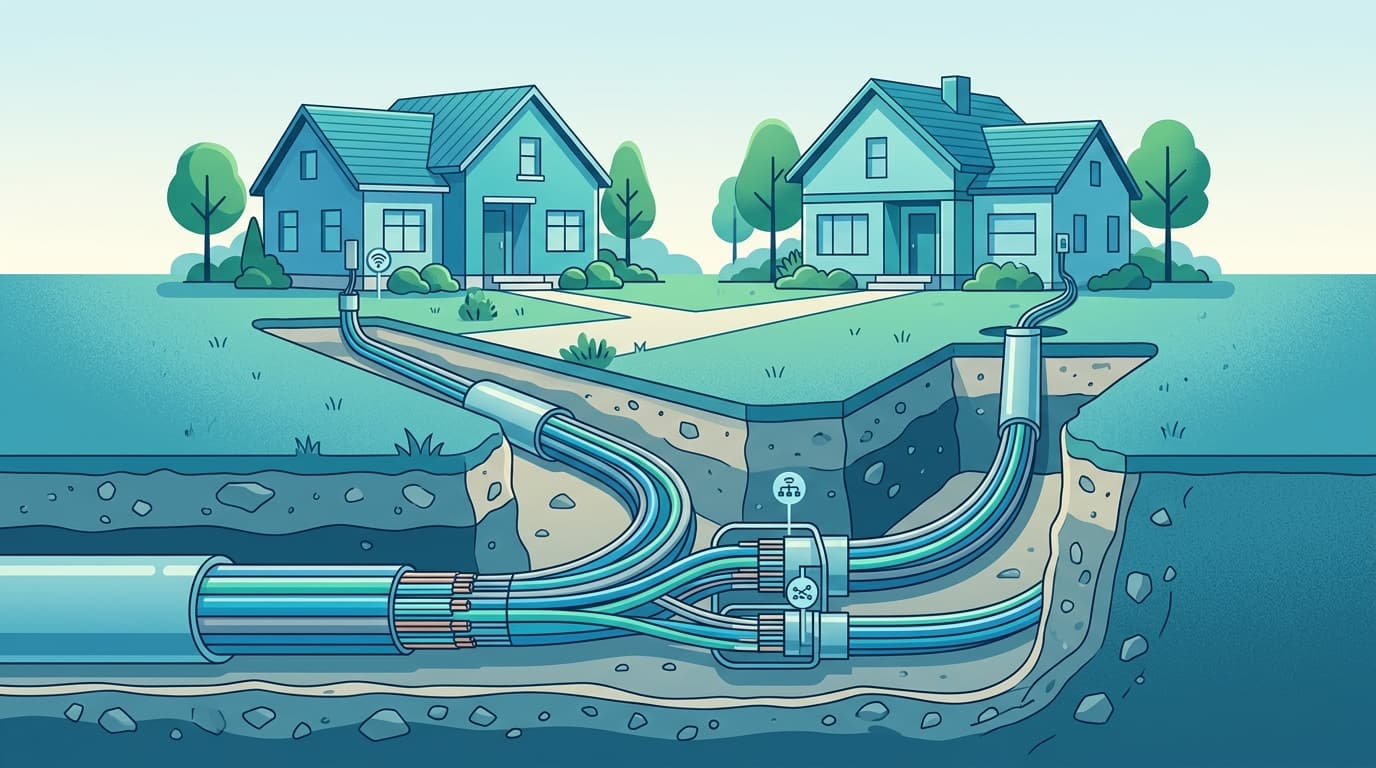
On the same street, two neighbours can get very different speeds: it all depends on the technology that reaches them. Cable delivers close to the advertised speed; VDSL fades with distance from the street cabinet. Before comparing prices, check what serves your address. That is what changes everything.
VDSL is internet over the copper phone line, extended by fibre up to the neighbourhood cabinet. Cable (DOCSIS) runs over the TV coaxial. Two different supports, two different behaviours — and a bill that can only be compared once the technology is known.
Cable or VDSL: what difference for your speed?
Cable is steadier, VDSL more temperamental. Cable holds the advertised speed; VDSL depends on the length of copper between you and the cabinet.
| Technology | Support | Real speed | Stability | Availability |
|---|---|---|---|---|
| Cable (DOCSIS) | TV coaxial | Close to advertised | Good (shared at night) | VOO + Telenet by region |
| VDSL | Copper + partial fibre | Varies with distance | Average | National |
| Fibre (FTTH) | End-to-end fibre | Symmetrical, held | Excellent | Minority of homes |
In practice, the average measured speed in Belgium sits around 100 to 120 Mbit/s download and 20 Mbit/s upload, according to Ookla data. Many VDSL homes pay for an "up to" they never reach, where an equivalent cable plan would have delivered it.
Why don't two neighbours get the same speed?
Because the distance to the cabinet and the available technology differ from one home to the next. On VDSL, the signal weakens as soon as you move away from the neighbourhood cabinet.
Take two houses 300 metres apart on the same street. The first, near the cabinet, pulls 70 Mbit/s on VDSL. The second, further away, caps at 35 on the same plan and the same price. Add fibre that has reached one but not the other, and the gap becomes a chasm. The national average says nothing about your living room.
Speed is not read off the price list, it is tested at your door.
How do I find out what serves my address?
Test your eligibility first. The result drives the real speed far more than the operator's name.
Where to check the available technology?
Enter your address on each operator's site or the IBPT coverage map. You will learn whether you are in a cable area (VOO in Wallonia and Brussels, Telenet in Flanders and Brussels), on VDSL (Proximus, Scarlet, edpnet) or eligible for fibre.
How do I recognise my current plan?
Look at your contract or your router. A VOO or Telenet plan is cable; a Proximus, Scarlet or edpnet plan is often VDSL, unless it says "Fiber". When in doubt, the online eligibility check settles it in thirty seconds.
Cable, VDSL or fibre: which to choose?
Fibre if available, otherwise cable, and VDSL as a last resort. That order maximises real speed for a comparable price.
Fibre offers symmetrical speed and a stability nothing matches, but it still reaches only a minority of Belgian homes in early 2026. Cable is the best available compromise today for most urban addresses. VDSL stays relevant when it is the only technology served and your distance to the cabinet is short. For the operators and prices in detail, see our guide Which internet provider should you choose in Belgium?.
Does the price change with the technology?
Not directly, but the speed-to-price ratio does. At €30, cable gives you a speed that holds; VDSL at the same price can disappoint depending on your address.
In short: technology first, price second. Test your eligibility, compare what actually serves your home, then let the price tag separate equivalent offers. It is the only method that stops you paying for a speed you will never see.
Frequently asked questions
Maxime suit le marché télécom belge depuis dix ans. Il épluche les grilles tarifaires de Proximus, Orange, Telenet, VOO, BASE et des MVNO pour traduire le jargon (VDSL, câble, Easy Switch, 4play) en conseils utilisables.