Best Internet Provider for Gaming in Belgium
Best internet provider for gaming in Belgium: latency, upload and real price compared. Fibre, cable or VDSL, the right pick for your gamer profile.
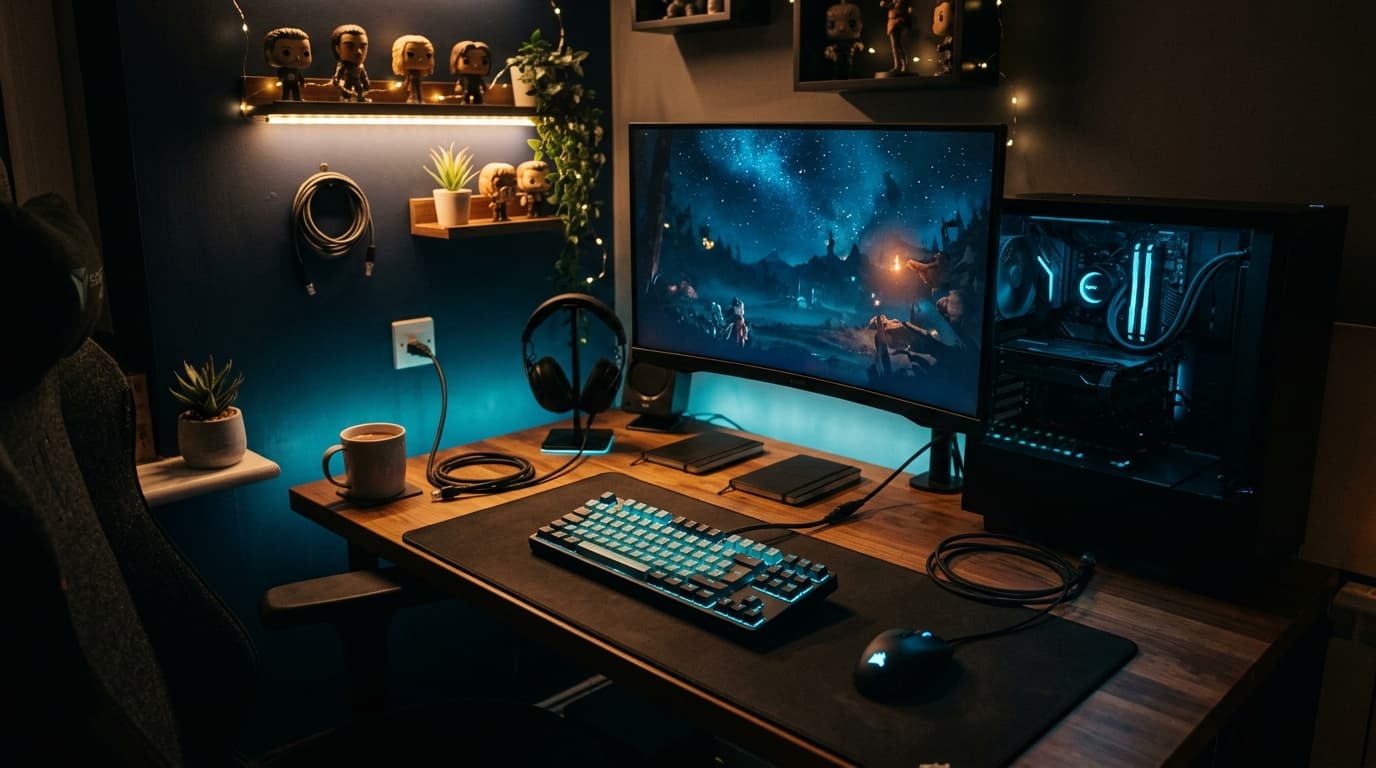
For gaming in Belgium, fibre FTTH offers the lowest latency, around 5 ms, and comfortable upload. Proximus deploys it, but Scarlet, edpnet and Mobile Vikings run on the same socket, often cheaper. Without fibre at your address, Telenet or VOO cable stays very good. The real deciding factor is latency at your door, not the advertised speed.
Latency, or ping, is the time a signal takes to travel to the game server and back, measured in milliseconds. It's what decides whether your shot fires on time, not the download speed the ads push. In short: a 2 Gbps plan badly placed loses to a small, stable fibre line.
Which internet provider to choose for gaming in Belgium?
For most Belgian gamers, fibre FTTH is the best choice. Proximus is the only one actively deploying it, but Scarlet, edpnet and Mobile Vikings run on the same socket, sometimes for €10 to €15 less. Without fibre at your address, Telenet cable in Flanders or VOO in Wallonia and Brussels does almost as well.
Fibre wins for two reasons: latency around 5 ms and a dedicated line, immune to your neighbours. Its weakness is elsewhere: in 2026, it still reaches only 20 to 30% of Belgian homes (Selectra, 2026). Coaxial cable, by contrast, covers almost the whole country and runs between 10 and 20 ms, a gap that is imperceptible for a relaxed gamer.
In Louvain-la-Neuve, a student connected to fibre via Scarlet plays at 6 ms of ping. Three streets away, with no fibre socket, VOO cable leaves his neighbour at 16 ms: invisible in console gaming, noticeable the moment he climbs into a ranked FPS match.
Speed or latency: what really matters to play?
Latency, not speed. An online game exchanges tiny packets of data, very often: it needs a low, steady ping, not gigabits of download. Around 25 Mbps download is enough to play with no problem.
What separates two connections is the trio of ping, jitter and packet loss. The practical threshold: under 20 ms for competitive, 20 to 50 ms for casual, and above 80 ms the lag shows (Selectra, 2026). Jitter, that second-to-second variation in ping, should stay under 5 ms, otherwise your movement "stutters" even with a good average ping. Upload, often forgotten, matters as soon as you play online: aim for at least 20 Mbps to avoid desync in multiplayer.
At equal reflexes, a Valorant player at 12 ms beats an opponent at 60 ms. Those 48 ms of difference are worth nearly three frames of delay at 60 fps in every duel: enough to lose the exchange before you've even seen the enemy.
Fibre, cable or VDSL: which technology for gaming?
In order: fibre FTTH, then coaxial cable, then VDSL. Fibre drops to about 5 ms with symmetric upload and immunity to electrical interference. Cable follows close behind. VDSL, over the copper line, climbs to 15-30 ms and weakens with distance to the telephone exchange.
The table below cross-references the three technologies available in Belgium in 2026. Availability often decides for you: no point aiming for fibre if your street isn't wired yet.
| Tech | Max download | Upload | Latency | Availability |
|---|---|---|---|---|
| Fibre FTTH | up to 8.5 Gbps | symmetric | ~5 ms | 20-30% of homes |
| Coaxial cable | 1 to 2.5 Gbps | 20-500 Mbps | 10-20 ms | very wide (Flanders/Wallonia) |
| VDSL | 100-200 Mbps | 20-50 Mbps | 15-30 ms | near-universal |
In practice, VDSL stays playable for casual gaming, but its real ping ranges from 30 to 80 ms depending on how far you are from the exchange (Selectra, 2026). If you play seriously, first test what's connectable at your home: it's the starting point for everything else.
Comparison of gaming internet offers in Belgium
Prices collected in July 2026 from Astel and Selectra, promotions included where they apply. The table shows the intro price then the post-promo price, because that's what you'll pay most of the year. All these offers suit online gaming; upload and technology make the difference for streamers.
| Offer | Tech | Download | Upload | Real price /month |
|---|---|---|---|---|
| BASE Internet Unlimited | Cable | 200 Mbps | 20 Mbps | €40 |
| Scarlet Loco + Fiber Boost | Fibre | 300 Mbps | 30 Mbps | €44 |
| Proximus Internet Mega Fiber | Fibre | 500 Mbps | 100 Mbps | €44.99 then €64.99 |
| edpnet Fiber XL | Fibre | 500 Mbps | 100 Mbps | €49.95 |
| Mobile Vikings Fibre super fast | Fibre | 1 Gbps | 500 Mbps | €55 |
| Telenet Internet Turbo | Cable | 2.5 Gbps | 100 Mbps | €55 then €85 |
| Orange Internet Giga | Cable | 1 Gbps | 20 Mbps | €57 then €72 |
| Proximus Internet Giga Fiber | Fibre | 2 Gbps | 200 Mbps | €57.99 then €77.99 |
| VOO GIGA Rapide | Cable | 1 Gbps | 50 Mbps | €74 |
| Mobile Vikings Fibre hyper fast | Fibre | 5 Gbps | 1 Gbps | €90 |
Is coaxial cable reliable in the evening for gaming?
Yes, with one caveat. The last segment of the Telenet or VOO network is coaxial cable shared between neighbours: at peak hours, often between 8 and 11 pm, speed can drop and ping can rise (Selectra, 2026). On fibre FTTH, the line is dedicated all the way to your home, so no contention.
The useful habit: run a speed test several times, including one in the middle of the evening, before judging a cable offer. A steady ping at 10 pm beats a great figure measured at 10 am, when nobody in the neighbourhood is gaming.
Which provider for your gamer profile?
The right pick depends on how you play, not on a ranking by highest speed. Four profiles, four different priorities.
For a competitive FPS or MOBA player, latency comes first: aim for fibre FTTH if it reaches you (Proximus, or Scarlet and edpnet, cheaper on the same socket), otherwise a good Telenet or VOO cable. For a Twitch or YouTube streamer, upload is what counts: Mobile Vikings fibre (500 to 1000 Mbps upstream) crushes asymmetric cable capped at 20-50 Mbps. For a relaxed console gamer, cable or even fast VDSL is plenty, so keep the cheapest offer. For cloud gaming, stability matters more than raw speed.
✓ Pros
- Fibre FTTH: lowest latency (~5 ms) and steady
- Symmetric upload, ideal for live streaming
- Dedicated line: no shared slowdown in the evening
✗ Cons
- Fibre available at only 20-30% of addresses
- Intro price that rises after 6 to 12 months
- Installation fee if the fibre socket doesn't exist yet
Do you need fibre for cloud gaming (GeForce Now, Xbox)?
No, not necessarily. Cloud gaming, on GeForce Now or Xbox Cloud Gaming, mainly needs a stable connection of around 25 to 35 Mbps download and controlled latency. A good cable, or even fast VDSL, is enough.
What weighs most isn't the technology but the weakest link between your controller and the server: a saturated Wi-Fi or a box far from your couch will do more damage than a slower subscription. Plug in over Ethernet and pick the nearest server before blaming your provider.
What does a good gaming connection really cost?
Count on €40 to €58/month at the intro price for a comfortable offer, but watch the post-promo rate. Several gaming-friendly offers climb once the discount ends: Telenet Internet Turbo at €85, Proximus Internet Giga Fiber at €77.99 (Astel, July 2026).
Two costs often slip under the radar. Installation fees, when a fibre socket has to be laid, and the premium for a speed you don't need: paying €90 for 5 Gbps only makes sense if you stream in 4K or share the connection between several gamers. To play solo, a 500 Mbps offer does exactly the same job in-match.
Don't forget the address angle: the technology connectable at your home, fibre, cable or VDSL, decides which offers are actually available, as our guide on cable or VDSL: why your address changes everything explains. An advertised 2 Gbps plan is worthless if it doesn't reach your door.
To dig deeper, compare the best internet provider, read our guide to choosing your internet provider, or see which provider suits remote work. To switch cleanly, the Easy Switch process is overseen by the IBPT (the Belgian telecom regulator).
Frequently asked questions
Maxime suit le marché télécom belge depuis dix ans. Il épluche les grilles tarifaires de Proximus, Orange, Telenet, VOO, BASE et des MVNO pour traduire le jargon (VDSL, câble, Easy Switch, 4play) en conseils utilisables.