Which internet provider should you choose in Belgium?
Compare Belgian internet providers: cable, fibre or VDSL by your address, real price after the promo, and how to switch without downtime.
The best internet provider in Belgium depends first on your address, not on the headline price. Cable (VOO, Telenet) and fibre deliver the advertised speed; VDSL fades with distance from the street cabinet. Check the technology available where you live, then compare the real price after the promotion. That order is what saves money.
An internet provider is the company that sells you access, but not always the physical network reaching your door. In Belgium, the technology at your address — cable, fibre or VDSL — matters as much as the brand on the bill. It is the first thing to check, before the price.
Where should you start when choosing an internet provider?
Start with your address, not with a price ranking. The technology available where you live sets the real speed you will get; price only separates the operators that already cover your street.
Most comparison sites publish an "all technologies" top 10, cheapest to most expensive. The problem: a €23 VDSL plan can advertise "up to 70 Mbit/s" and deliver 30 if you are far from the cabinet, while a cable plan at the same price keeps its promise. The price tells you nothing until you know what reaches you.
The method has three steps: test your eligibility (fibre, cable or VDSL) on the operators' sites or via the IBPT comparison tool, keep the two or three providers that cover your address, then compare their real price after the promo. Our internet comparison tool ranks plans by these criteria rather than by the headline rate alone.
Cable, fibre or VDSL: which technology reaches you?
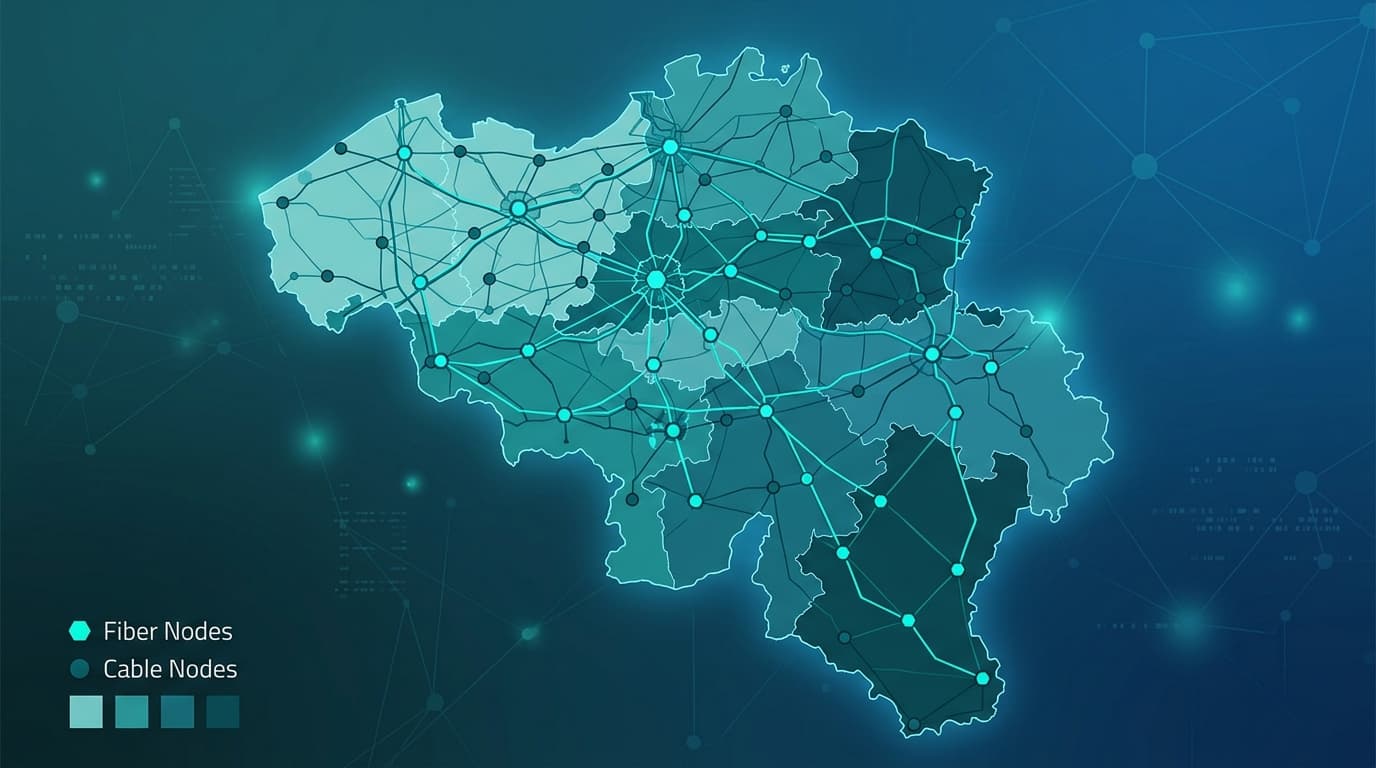
Three technologies share the Belgian map, and they are not equal. Cable and fibre deliver close to the advertised speed; VDSL depends on your distance from the cabinet.
Fibre (FTTH) carries data as light: symmetrical speed (as much up as down), very low latency, no slowdown at peak times. It is the best technology, but it still reaches only a minority of Belgian homes in early 2026, despite the faster rollout by Proximus, Orange and Telenet. Cable (DOCSIS) from VOO (Wallonia and Brussels) and Telenet (Flanders and Brussels) offers excellent download speeds, more modest upload, and bandwidth shared with the neighbourhood that can slow down in the evening. VDSL runs over the copper phone line: available almost everywhere, but its speed drops with distance from the cabinet.
In practice, the average measured speed in Belgium sits around 100 to 120 Mbit/s download and 20 Mbit/s upload, according to Ookla data. Many households pay for an "up to" they never reach.
How do I know if fibre is available at my address?
Enter your address on a fibre operator's site or the IBPT tool. The answer is binary: either fibre is run to your home, or it is not yet. There is no point signing a "fibre" contract if the connection is not planned for the coming months.
Is cable really shared with the neighbours?
Yes. Cable pools a neighbourhood's bandwidth. During the day the effect is invisible; on a Sunday streaming evening, the speed can dip. Fibre does not share the last segment, hence its superior stability.
Are VDSL and ADSL the same thing?
No. ADSL is the old, slow generation; VDSL pushes fibre to the neighbourhood cabinet, then finishes in copper. The shorter that copper run, the better the speed. That is why two neighbours a few streets apart get different speeds.
Which is the cheapest internet provider in Belgium?
On 5 June 2026, the cheapest plan is DIGI 5G Home Internet at €7/month, which replaces the fixed line with the 5G network. For a classic fixed connection, Scarlet Poco starts at €23/month.
In the mid range, edpnet VDSL XS is €25.95/month unlimited (20 Mbit/s), and hey! telecom offers 200 Mbit/s unlimited for €29/month — one of the best speed-to-price ratios right now. DIGI Fiber Essentials drops to €10/month where fibre is laid. These rates come from the public price lists recorded by Selectra in early June 2026.
Belgian internet providers compared
Here are the main providers ranked by dominant technology, entry price and coverage area. Speeds are indicative: only a test at your address is reliable.
| Provider | Technology | From | Typical speed | Commitment | Area |
|---|---|---|---|---|---|
| DIGI | 5G / fibre | €7 | 100 Mbit/s+ | None | Where rolled out |
| Scarlet | VDSL / cable | €23 | 30–100 Mbit/s | None | National (Proximus network) |
| edpnet | VDSL / fibre | €25.95 | 20–500 Mbit/s | None | National |
| hey! telecom | VDSL / cable | €29 | 200 Mbit/s | None | Depends on area |
| VOO | Cable | €38 | Guaranteed | 12 months | Wallonia, Brussels |
| Telenet | Cable | €40 | High | Varies | Flanders, Brussels |
| Proximus | VDSL / fibre | €42 | Fibre if eligible | Varies | National |
Should you choose fibre when it is available?
Yes, in most cases. At a comparable price, fibre offers symmetrical speed and a stability that neither cable nor VDSL matches. The only real brake is the price after the promotion.
Take a worked example. Proximus Internet Mega Fiber (500 Mbit/s, unlimited) is €44.99/month on a twelve-month promo, then €59.99/month. Over two years that is roughly €1,350 against close to €800 for a cable plan at €34/month. Fibre justifies the extra if you work from home, send large files or game online; for browsing and family streaming, a good cable plan is plenty.
How do you switch internet provider without downtime?
Switching goes through Easy Switch, the system overseen by the IBPT (Belgian telecom regulator). You give your Easy Switch ID to the new operator, who terminates the old contract and coordinates the changeover for you.
The line must be ported within one working day after validation. If it is late, the IBPT sets compensation of €3 per day. The risk of lengthy downtime mainly arises when you change technology — for example cable to VDSL — or when a technician must install new hardware. Keep your old router until the new connection is confirmed. To compare before you jump, use our internet comparison tool.
Which internet provider for which profile?
The right choice depends on your usage and your address, not on an absolute ranking. Here are the most common profiles.
✓ Go for
- Small budget: DIGI (from €7) or Scarlet (€23)
- Home working and large files: fibre if eligible
- Family streaming: VOO or Telenet cable
- Poorly served address: Proximus or edpnet VDSL
- First subscription: a no-commitment plan
✗ The traps
- Avoid the headline price without checking the post-promo rate
- Avoid a 24-month commitment if fibre is coming soon
- Avoid an 'up to' VDSL figure without testing your distance from the cabinet
Take Sofia, who has just moved into a Brussels flat poorly served by fibre: the right reflex is to test her cable eligibility (Telenet and VOO both cover Brussels) before looking at any price. Once the technology is known, the choice narrows to two or three offers, and the decision becomes simple.
In short: address first, price second. It is the opposite of what most comparison sites do, and it is what stops you paying for a speed you will never see.
Frequently asked questions
Maxime suit le marché télécom belge depuis dix ans. Il épluche les grilles tarifaires de Proximus, Orange, Telenet, VOO, BASE et des MVNO pour traduire le jargon (VDSL, câble, Easy Switch, 4play) en conseils utilisables.