TV Provider for a Family in Belgium: Which to Choose?
TV provider for a family in Belgium: kids' channels, simultaneous screens, replay and the new 2026 parental controls compared across Proximus, Telenet, VOO and Orange.
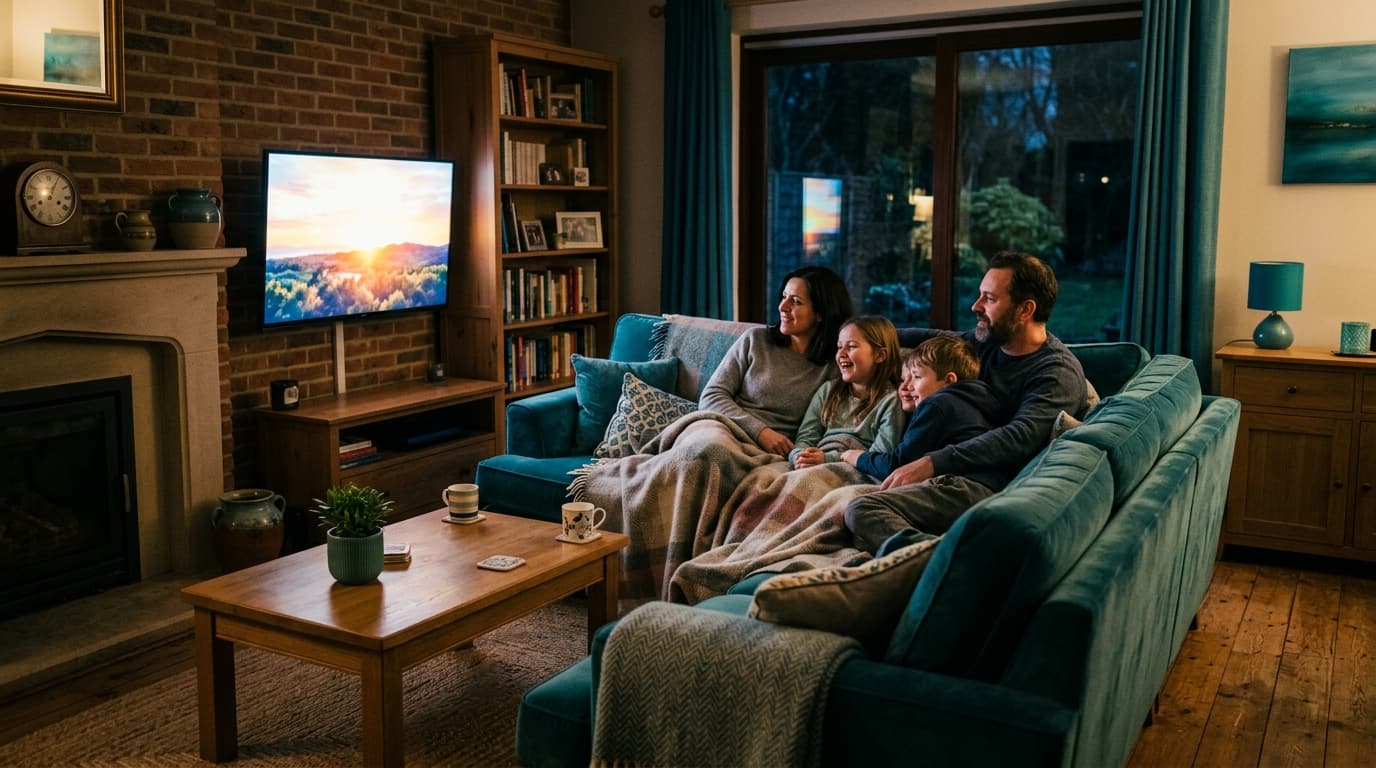
In Belgium, the best TV provider for a family is the one that combines a free kids layer, enough simultaneous screens and a long enough replay window, not the one with the most channels. Proximus, Telenet, VOO and Orange mainly differ on those three criteria. Here's how to decide for your household, at your address, without paying for options you don't need.
A family TV provider here means the TV offer best suited to a household with children: accessible kids' channels, several simultaneous streams so everyone watches their own thing, a generous enough replay window to catch a missed cartoon, and clear parental controls. It isn't an official operator range, but it's the angle that really matters once you have children.
What makes a good TV provider for a family?
It's an offer that solves three concrete problems: children find their programmes, several people watch at once, and you can rewatch a missed show. The total channel count, the classic brochure argument, says almost nothing about a family's experience.
The base bundles of the four big operators look very similar, around 70 to 80 channels each. The real difference lies elsewhere: replay length, the number of simultaneous screens and the kids' channels included at no extra cost. A household without children can ignore these criteria; a family lives all of them every day, between the morning cartoon and the series the parents want to rewatch at night.
Another useful reflex before paying: your address decides the technology. Cable (Telenet in Flanders, VOO in Wallonia and Brussels) and VDSL or fibre (Proximus, Orange) aren't equal everywhere, and that affects the bandwidth available for several simultaneous TV streams. Our guide to which TV provider to choose in Belgium covers this starting point.
Which children's channels are included with each operator?
The free kids layer is the same everywhere, and many families forget it before paying for an option. Auvio Kids, the RTBF's youth service (successor to OUFtivi), is free, ad-free and designed for ages 3-12 in Wallonia and Brussels. In Flanders, Ketnet (VRT) plays the same role. This layer exists whatever your operator.
Above this layer, each operator adds themed kids channels to its bundle, but the real gap is small for a young child. The question to ask isn't "how many kids channels?" but "does the free layer plus two or three channels do the job, or do I really need a paid option?". For most households with young children, the free layer already covers the essentials.
| Family item | Proximus (Pickx) | Telenet | VOO | Orange |
|---|---|---|---|---|
| Main technology | VDSL / fibre | Cable | Cable | VDSL / fibre |
| Free kids layer | Auvio Kids | Ketnet | Auvio Kids | Auvio Kids |
| Bundle kids channels | Yes | Yes | Yes | Yes |
| Multi-screen app | Pickx | Telenet TV | VOO | Orange TV |
The free kids layer (Auvio Kids in Wallonia and Brussels, Ketnet in Flanders) is available whatever the operator; themed channels vary by bundle.
How many simultaneous screens does a family need?
At least two, often three to four once children each want their own programme. It's the most underestimated criterion, yet the most decisive when not everyone feels like watching the same thing at the same time.
In practice, a base decoder frequently allows two parallel streams: one in the living room, one in a bedroom or on a tablet. Higher tiers and multi-screen options usually go up to five streams, depending on the operator and the plan chosen. A family of four where everyone watches separately should therefore check this figure before signing, because it decides whether the TV really "keeps up" with everyone.
Does a child on a tablet count as a screen?
Yes. As soon as a stream goes to a tablet or smartphone via the operator's app, it takes one of the simultaneous slots included in your plan. A family that lets a child watch a cartoon on a tablet while a match is on in the living room is already using two streams. That's where two-screen offers quickly show their limits.
Does multi-screen work away from home?
Often yes, via the app. The major operators allow mobile viewing away from home, handy for keeping a child busy on the train or at the grandparents'. The detail to check: some channels can only be streamed at home for rights reasons, and the number of out-of-home streams may be more limited than at home.
Which operator offers the best replay for children?
Cable, clearly. On its base tier, Proximus (Pickx) offers about 36 hours of replay, while Telenet and VOO reach 7 days on cable. For a family, this gap isn't theoretical: it's the difference between being able to replay Wednesday's cartoon on Sunday, or having already lost it.
Replay is probably the most concrete kids criterion. Children rarely watch live; they catch up, rewatch, demand the same episode. A 36-hour window forces you to schedule a recording or switch to a catch-up app, whereas seven days leaves room to breathe. Higher TV tiers and cloud recording options extend this window with Proximus, but at an extra cost. Our comparison of TV replay and recording prices each offer in detail.
For a family, seven days of replay versus thirty-six hours is the difference between rewatching Wednesday's cartoon and having already lost it.
How do the new 2026 parental controls change the choice?
They standardise the baseline, which shifts the choice toward usability. The rating scheme of the Wallonia-Brussels Federation (FWB) took effect on 1 July 2026 and applies to all channels and all on-demand services, whatever the operator. It introduces six age categories (all audiences, 6, 10, 12, 16 and 18) and content descriptors (violence, fear, sex, substances, language, discrimination).
Two changes matter for a family. First, access to the most sensitive on-demand content is now protected by a parental code. Second, the old broadcast time-slot restrictions have been removed: a rated programme can air earlier, which makes the labelling and locking all the more useful. Since this baseline is common to every operator, the choice comes down to how simple the parental code is and how clear the interface, not to whether the feature exists.
The real cost of a family TV provider after the promo
The headline rate of the first twelve months says nothing about a family's budget over time. Most TV offers, on their own or in a bundle, rise after the welcome promotion, often at the twelve-month mark. A family keeping its subscription for several years mainly pays the post-promo rate, not the shop-window price.
The useful reflex: ask for the price after the promotion before signing, and compare it with what internet alone costs. In a bundle, TV is sometimes almost thrown in, which makes keeping it logical; in other cases, the real gap between "internet only" and "internet + TV" is higher than advertised. If several SIM cards come into play, a multi-line family bundle often changes the maths. And if your children mostly watch on streaming, TV without an operator subscription is worth putting on the table before paying for a full bundle.
✓ Pour
- Free kids layer (Auvio Kids, Ketnet) common to all operators
- Cable (Telenet, VOO): 7-day replay, valuable for children
- Multi-screen apps to keep everyone busy on their own device
- Parental controls now harmonised by the 2026 FWB rating scheme
✗ Contre
- Short base replay with Proximus (36 hours) without a paid option
- Simultaneous screens limited to two on entry tiers
- Price that climbs after twelve months of promotion
- Cable isn't available everywhere: the address decides
Which TV provider should your family choose?
It depends on your address and on what you watch, not on a universal ranking. Cable takes the edge for replay and multi-screen; VDSL or fibre stay relevant where cable doesn't reach, or when the rest of the bundle makes the difference.
For a family with young children who catch up a lot, the 7-day cable replay (Telenet in Flanders, VOO in Wallonia and Brussels) is the strongest argument. For a household already with Proximus or Orange for internet and mobile, keeping the same operator for TV simplifies the bill, provided you accept the shorter base replay or take a recording option. For a large family where everyone watches separately, the number of simultaneous screens comes first: aim for a tier or option that reaches four or five streams. And for a tight budget, remember that the free kids layer plus two or three channels already covers a lot, before any option.
To go further, compare all the bundles in our guide to which TV provider to choose in Belgium and our look at TV replay and recording. The protection of minors itself falls under the CSA in the Wallonia-Brussels Federation.
Frequently asked questions
Maxime suit le marché télécom belge depuis dix ans. Il épluche les grilles tarifaires de Proximus, Orange, Telenet, VOO, BASE et des MVNO pour traduire le jargon (VDSL, câble, Easy Switch, 4play) en conseils utilisables.