Android TV box in Belgium: which one should you buy?
Android TV box in Belgium: does your operator's app run on it, what to check before buying, budgets, and where the legal line sits on IPTV boxes.
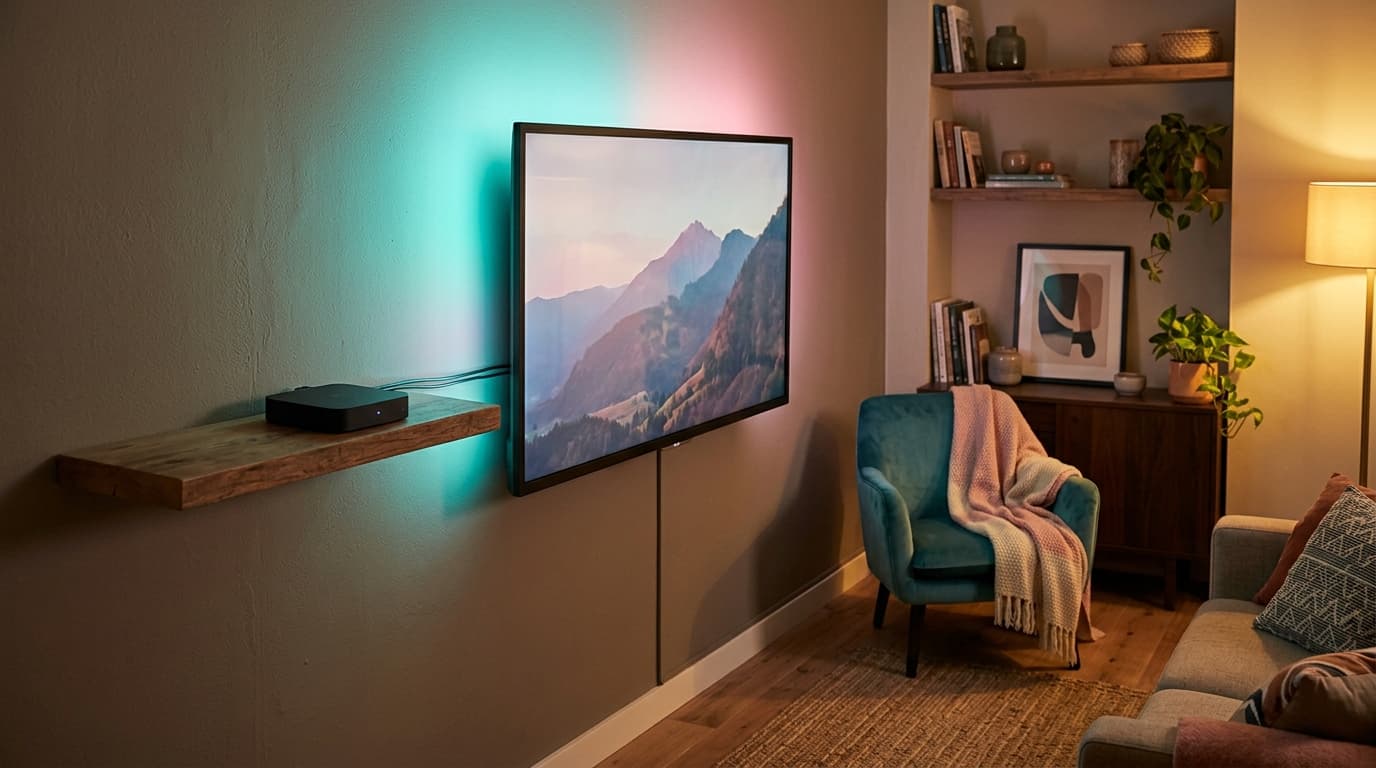
An Android TV box turns a non-connected television into a smart one, for €45 to €190 depending on the model. In Belgium, though, the useful question is not "which one is the most powerful" but "does my operator's app exist on it". That single detail decides whether you save the cost of a second set-top box or buy a half-useless object.
An Android TV box is a small computer that plugs into a television over HDMI and installs Google's Android TV system on it, app store included. It receives nothing on its own: it plays whatever your internet connection sends it.
An Android TV box replaces the television's electronics, not the subscription
This is the most common confusion, and an expensive one. The box brings a system, a remote control and an app store to a screen that has none, or whose own system has become too slow. It brings no content whatsoever.
In practice, a television bought in 2015 without smart features becomes usable again: Netflix, Disney+, YouTube, Auvio and operator apps all become installable, provided they exist for that platform. The difference with an HDMI dongle such as a Chromecast is one of nature: the dongle receives a stream pushed from your phone, while the box runs the app itself, with its own remote. Google has moved its own range towards the second approach.
Android TV or Google TV, what is the difference?
None that matters to you. Google TV is an interface layered on top of Android TV, built around film and series recommendations; the underlying system, the app store and the certifications are identical. A device sold as "Google TV" therefore accepts exactly the same operator apps as one sold as "Android TV".
Does it replace your operator's set-top box?
Sometimes. Most buying guides stop before that question, because they are written for the French market, where the app landscape is different. In Belgium, the answer depends on the operator and the platform, and it moves.
Here is what our check on 21 August 2026 produced, based on operator support pages, press releases and app listings published on the Belgian stores.
| App (operator, carrier network) | Apple TV (tvOS) | Android TV / Google TV | Fire TV (Fire OS) | Chromecast / AirPlay |
|---|---|---|---|---|
| Pickx — Proximus (own copper and fibre) | Yes, Belgian App Store | No, Android mobile app only | Not documented | Chromecast yes |
| Telenet TV — Telenet (own cable, Flanders and Brussels) | Yes | Yes | Not documented | Chromecast and AirPlay |
| Orange TV — Orange (own mobile, ex-VOO Walloon cable) | Yes | Not confirmed | Not documented | Chromecast yes |
| BASE App TV — BASE (Telenet group) | Not confirmed | Not confirmed | Not documented | Via smart TV and casting |
Checked on 21 August 2026. Cells marked "not confirmed" are those for which no official source was available at the time of checking: we would rather say so than guess. App catalogues change: check your box's own store before buying.
Translated into a purchase decision, this gives a simple and slightly counter-intuitive rule. A Telenet customer has the widest choice and can aim at an inexpensive Android TV box. A Proximus customer who wants their channels on a second screen without a set-top box has to go through an Apple TV, or cast from a phone: there is no Pickx app for Android TV, and no €50 box will change that. Proximus knows it well enough to offer the Apple TV as a replacement for its own Android-based decoder on some offers.
What should you check before buying?
Five things, in this order. The first three eliminate half the models sold online, and price only shows up afterwards.
- Your operator's app exists on the platform. The only criterion that truly decides. Check inside the device's own app store, not on the retailer's product page.
- Widevine L1 certification. This is Google's content protection system. At level L1, decoding happens in hardware and HD or 4K are allowed; on a non-certified box, or one limited to L3, Netflix stays capped around 480p whatever your speed. A generic €25 box almost always falls into that category.
- Official Google certification. A certified device receives updates and reaches the full Play Store. Unlicensed boxes run a modified Android, without security updates, and sometimes without the ability to install the apps you actually want.
- An Ethernet port. For a living-room television handling 4K, a cable stays more stable than Wi-Fi shared with the rest of the household. HDMI dongles have none; boxes often do.
- Audio and video output. 4K HDR if your television makes use of it, Dolby Atmos if you have a soundbar. No point paying for HDR on a Full HD screen from 2015.
What if my television is already a smart TV?
Then you may have nothing to buy. The Pickx, Telenet TV, Orange TV and BASE App TV apps install directly on Samsung, LG, Philips and Sony connected televisions from the 2019 model year onwards. A box is only worth it if your set is older, if its system has become painfully slow, or if the screen's brand is not supported.
Which box for which budget?
Three tiers, and one to avoid. The prices below are public prices observed on 21 August 2026 at Belgian and European retailers; they move often, and the manufacturer's official page is what counts.
| Tier | Example models | Public price observed (21/08/2026) | What you get | Setup time |
|---|---|---|---|---|
| Entry | Amazon Fire TV Stick 4K Max, Xiaomi TV Box S | €45 to €60 | 4K, Fire OS or Android TV catalogue, no Ethernet on sticks | 15 min |
| Mid | Google TV Streamer 4K | €119 (official Google price) | Certified Android TV, Ethernet, full remote | 15 to 20 min |
| High | Apple TV 4K (64 or 128 GB), Nvidia Shield TV Pro | €170 to €190 for the Apple TV 4K | The only route to Pickx without a decoder, fastest interface | 20 min |
| Avoid | Generic "all channels included" boxes | €25 to €80 | Widevine L3, no updates, illegal setup (see below) | — |
The calculation that matters to a Belgian household is quick. If your operator charges €9/month for a second decoder, you pay €216 over twenty-four months for a device that never becomes yours; an Apple TV 4K bought once costs less, lasts longer and follows you if you switch operator. One caveat: the second-decoder rate has moved several times at Proximus and public sources diverge, between €1/month on some plans and €9/month on others in spring 2026. Ask for the figure that applies to your own contract before reaching for your card: at €1/month, the arbitrage flips completely.
Does the Chromecast still exist?
Not in that form. Google discontinued the Chromecast with Google TV range and replaced it with the Google TV Streamer, a full box sold at €119, launched in September 2024. The casting function itself survives: it is built into most recent connected televisions and remains, for a Proximus customer without an Apple TV, the simplest way to push Pickx onto a second screen.
Setting up your box: four steps, twenty minutes
- Plug the box into a free HDMI port on the television, then its power supply. Switch the television to that source.
- Connect it to the network, over Ethernet if the port exists and the socket is close enough, over Wi-Fi otherwise. Allow five minutes of updates on first boot.
- Open the app store and look for your operator's app before anything else. If it is not there, stop: that is the moment to return the device, not after configuring everything.
- Sign in with your subscriber credentials, then install the rest: streaming services, Auvio, RTL play.
The classic mistake is doing step 3 last. You spend an evening setting everything up, tidying cables and programming the remote, only to discover when launching the channels that the app does not exist for that platform, when ninety seconds of searching in the store, before even fully unboxing the device, would have given the answer.
Is a box with "IPTV subscription included" legal in Belgium?
No. And that has to be said before talking about price, because it is exactly what Belgian search returns in volume: queries around "IPTV box" exceed a thousand monthly searches in Belgium, far ahead of the honest Android TV box.
The hardware is not the problem: a box remains a neutral object, like a disc player. The illegality lies in the pirate subscription preloaded on it, redistributing channels and sports competitions without a licence. The CSA has a page dedicated to the subject, and Test-Achats documents the framework in place: since 2024, Belgian internet providers block domains linked to illegal IPTV on court order, and one ruling allows the block to extend to mirror sites without returning to court. In February 2026, the Belgian courts named five pirate subscriptions.
The heaviest penalties target resellers, with fines that can reach €100,000 and prison sentences. End users are less exposed in practice, but they are not in a blind spot of copyright law, and they pay for a service that dies the day the domain is blocked. Belgian daily La Libre already estimated in 2023 that at least half a million Belgians were using one.
The box is not illegal. The subscription sold with it is, and it is the one that dies when a judge blocks the domain.
Do you really need to buy a box?
Often, no. This is the advice you will not find on a retailer's page, and it holds for a good share of Belgian households.
If your television dates from 2019 or later and carries a Samsung, LG, Philips or Sony badge, your operator's app installs on it directly: the box adds nothing. If you are with Proximus and do not want an Apple TV, casting from your phone covers occasional guest-room use for zero euros. And if your need amounts to a few hours a month on a second screen, renting a decoder at €1/month, where that rate is offered, is unbeatable.
A box earns its place in three cases: an old television still worth keeping, a smart TV whose system has become annoyingly slow, or a household cutting the cord that wants a single platform. There, buying once beats renting over twenty-four months.
To pick the subscription behind the screen, our guide on which TV provider to choose in Belgium takes the subject from the top, and our TV ranking gives the state of the Belgian market. If your plan is to drop the channel package altogether, see TV without an operator subscription; if catch-up matters most to you, our comparison of TV replay and recording puts figures on each offer.
Sources: Test-Achats — illegal IPTV banned in Belgium, CSA Belgium — illegal IPTV, Telenet press release on its TV app and the Pickx listing on the Belgian App Store. Prices and availability checked on 21 August 2026. IBPT is the Belgian telecom regulator; CSA is the French-speaking media regulator.
Frequently asked questions
Maxime suit le marché télécom belge depuis dix ans. Il épluche les grilles tarifaires de Proximus, Orange, Telenet, VOO, BASE et des MVNO pour traduire le jargon (VDSL, câble, Easy Switch, 4play) en conseils utilisables.