UPS for your internet router: one hour, then what?
A UPS keeps your router alive for about an hour. In Belgium your bundled landline dies anyway, and the operator says so on its own sales page.
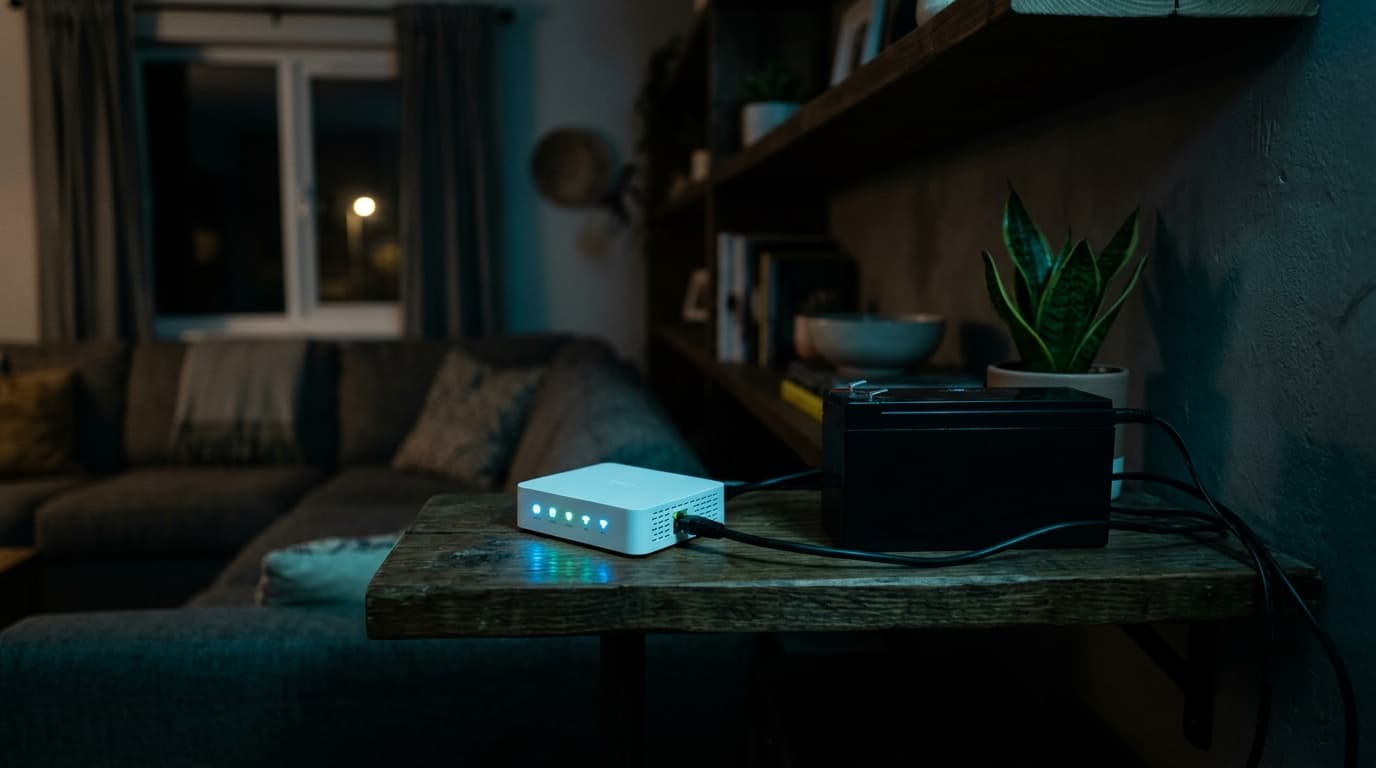
About an hour. That is roughly what a household UPS delivers on a Belgian router plus set-top box, and it is exactly what Proximus claims for the battery it sells at 99 euros. The price does not settle the real problem, though: your bundled landline still will not come back.
A UPS, or uninterruptible power supply, is a battery box sitting between the wall socket and your equipment. When mains power disappears, it takes over within milliseconds.
Your router dies the second the power goes
There is no subtlety here. Proximus writes it on its own help page: as soon as the modem loses power and shuts down, the internet connection stops, and television goes with it.
Wi-Fi vanishes at the same moment. The hallway camera, the kitchen speaker, the thermostat: everything that passes through the router stops, including devices that do have their own battery.
How long does a UPS last on a router?
Between twenty minutes and three and a half hours, depending on what you plug into it. The arithmetic takes two lines.
Ecoconso measured a Belgian modem and set-top box at roughly 25 W combined, which is more than 200 kWh a year if left running (RTBF, 29 August 2023). An entry-level unit such as the APC Easy UPS BV650I carries a 12 V, 7.0 Ah battery, so 84 Wh nominal, according to the Schneider Electric data sheet dated 19 September 2024. It does not return all 84: conversion losses and the discharge floor a lead-acid battery must not cross both take their cut. Count on half.
| What is plugged into the UPS | Load | Energy actually returned | Estimated runtime |
|---|---|---|---|
| Router alone, Wi-Fi on | 12 W | ~42 Wh | 3 h 30 |
| Router + set-top box on | 25 W | ~42 Wh | 1 h 40 |
| Router + set-top box + television | 120 W | ~42 Wh | 20 min |
| Router + set-top box + desktop computer | 200 W | ~42 Wh | 12 min |
The 25 W load comes from the Ecoconso figure published by RTBF on 29 August 2023; the 84 Wh capacity from the Schneider Electric data sheet for the BV650I, dated 19 September 2024. Efficiency taken at 50 %, calculated on 17 September 2026. These are estimates, not bench measurements.
The television is the trap to avoid. On the same UPS it divides runtime by five and turns ninety minutes of connectivity into a quarter of an hour of film.
99 euros at Proximus, and one line of small print
Proximus sells an Eaton 500 VA Backup Battery at 99 euros, VAT and Recupel included, checked on 17 September 2026. Three hundred watts, one inlet and four 230 V outlets, a lithium-ion battery rated for at least three years, two-year warranty. Claimed runtime: one hour for internet, Wi-Fi, VoIP calls and alarm connectivity.
Then, in the "good to know" box on that same page, this: the battery works when the fault is on your side, but not when the power cut affects the Proximus network.
Read that sentence twice. The operator selling the device warns you, on the sales page, that it will not help in a good share of the cases you would buy it for. An outage that hits your street usually hits the street cabinet, the VDSL box or the neighbourhood amplifier carrying your line as well, and the UPS in your living room can do nothing about that.
What if the outage does not stop at your meter?
It rarely does. Proximus publishes the only detailed table on the Belgian market showing what survives a power cut, and it deserves a line-by-line read.
| What still works | For how long | Why |
|---|---|---|
| Old copper landline with a corded handset | At least 4 hours | The line is powered by the network, not by your socket |
| Mobile calls and texts | At least 2 hours | Batteries installed on the masts |
| 4G mobile data | About 15 minutes | Dropped first to preserve voice |
| Fixed internet, TV, VoIP line | Zero, without a UPS | The modem needs mains power |
| Smaller operator network sites | About 4 hours | Batteries |
| Core network and data centres | No practical limit | Diesel generators |
Durations published by Proximus (which owns its copper, fibre and mobile networks) on its help page about power cuts, checked on 17 September 2026. Telenet, which runs its own cable network in Flanders and Brussels, and Orange, which runs its own mobile network plus the Walloon cable inherited from VOO, publish no equivalent table.
The ratio is hard to miss: the network lasts four hours, the mast two, and the battery the same operator sells for your living room claims one. The weakest link in the chain is the one in your home, and it is weakest by design.
The grey handset lasted four hours, the bundled line dies with the modem
Here is the loss nobody flagged to households at migration time, and it is the heaviest of the three.
A corded handset on an old copper line works without electricity, because the network powers it. Hence the four hours, and hence the ability to dial 112 when every other device in the house is dark. One caveat, which Proximus takes the trouble to spell out: a cordless handset does not work, since its base station needs mains power.
A bundled landline is a VoIP line, or a line carried over fibre. It goes through the modem. Modem off, line dead. The BIPT, for its part, notes that access to emergency numbers and services is not guaranteed on every internet telephony service and must be checked with your provider.
A household that traded copper for a 3play bundle therefore lost its backup phone without being told. A charged mobile covers the next two hours. That figure is the one Proximus gives for the batteries on its masts, and it assumes you stick to calls and texts, since mobile data is sacrificed well before. After that, the inter-operator arrangement routes emergency calls to a competitor's mast that still has power, and 112 becomes the only number you can reach. The other short numbers stop answering: our piece on Belgian emergency and short numbers sets out which ones.
Can a smart plug reboot the router remotely?
No, and the reason is mechanical. A smart plug such as the TP-Link Tapo P110 talks over 2.4 GHz Wi-Fi and is driven from an app. That Wi-Fi comes out of the router. Cutting power kills the router, so the Wi-Fi, so the plug.
It stays useful elsewhere. With mains power present and a device frozen, it restarts whatever sits downstream: the set-top box, a camera, the extender on the first floor. For the router itself, no smart plug does the job reliably, because it depends on the very device it is meant to restart. On that point, our comparison between renting your operator's extender and buying your own applies to the plug too: bought hardware follows you, rented hardware goes back.
Three situations justify buying one, and one does not
Remote work in a home with micro-outages comes first: a few seconds without power are enough to drop a video call and impose three minutes of modem reboot, several times a week. An internet-connected alarm system comes second, because the signal runs through the router and the monitoring centre receives nothing while it is off. A local cause of outage comes third: a tripping breaker, work on the fuse board, a building site in the basement. That is precisely the case where the operator's battery keeps its promise, since the network itself has lost nothing.
Five traps make the purchase pointless before the first outage:
- Not every socket is backed up. On some consumer Eaton units only three outlets out of six are; the other three filter surges and nothing more.
- Socket format. The APC Easy UPS BV650I ships with six IEC C13 outlets rather than Schuko, so a Belgian router's power brick will not fit without an adapter.
- Batteries age quietly. At least three years for the lithium unit at Proximus, three to five for the lead-acid one at Schneider Electric. A battery never tested is a battery found dead on the day it was needed.
- The television plugged in alongside. It multiplies the load by five and drags runtime below fifteen minutes.
- Commercial status. The Eaton Ellipse ECO range is listed as "to be discontinued" on the manufacturer's Belgian site as of 17 September 2026, and replacement batteries always follow the same path.
The case for buying nothing is the most common one. If your neighbourhood loses power once every two years, 99 euros for an hour of Wi-Fi makes no sense: charge the mobile, stick to texts during the outage to spare the mast battery, and keep a torch within reach. A spare corded handset only helps if you still have an old copper line. On a bundle, it will do nothing at all.
If the decision is about the bundle itself rather than the hardware, our ranking of Belgian bundles shows where the market stands.
Sources: Proximus help page on power cuts and Eaton 500 VA Backup Battery product page (both checked on 17 September 2026), BIPT/IBPT (emergency numbers, compensation for service interruption), Schneider Electric (APC Easy UPS BV650I data sheet, 19 September 2024), Eaton Belgium (Ellipse ECO range), RTBF and Ecoconso (modem and set-top box consumption, 29 August 2023).
Frequently asked questions
Maxime suit le marché télécom belge depuis dix ans. Il épluche les grilles tarifaires de Proximus, Orange, Telenet, VOO, BASE et des MVNO pour traduire le jargon (VDSL, câble, Easy Switch, 4play) en conseils utilisables.