Best Mobile Operator for Rural Areas in Belgium
Which operator gets the best signal in the Belgian countryside? Proximus, Orange, Base and DIGI compared in rural areas, plus fixes when coverage is poor.
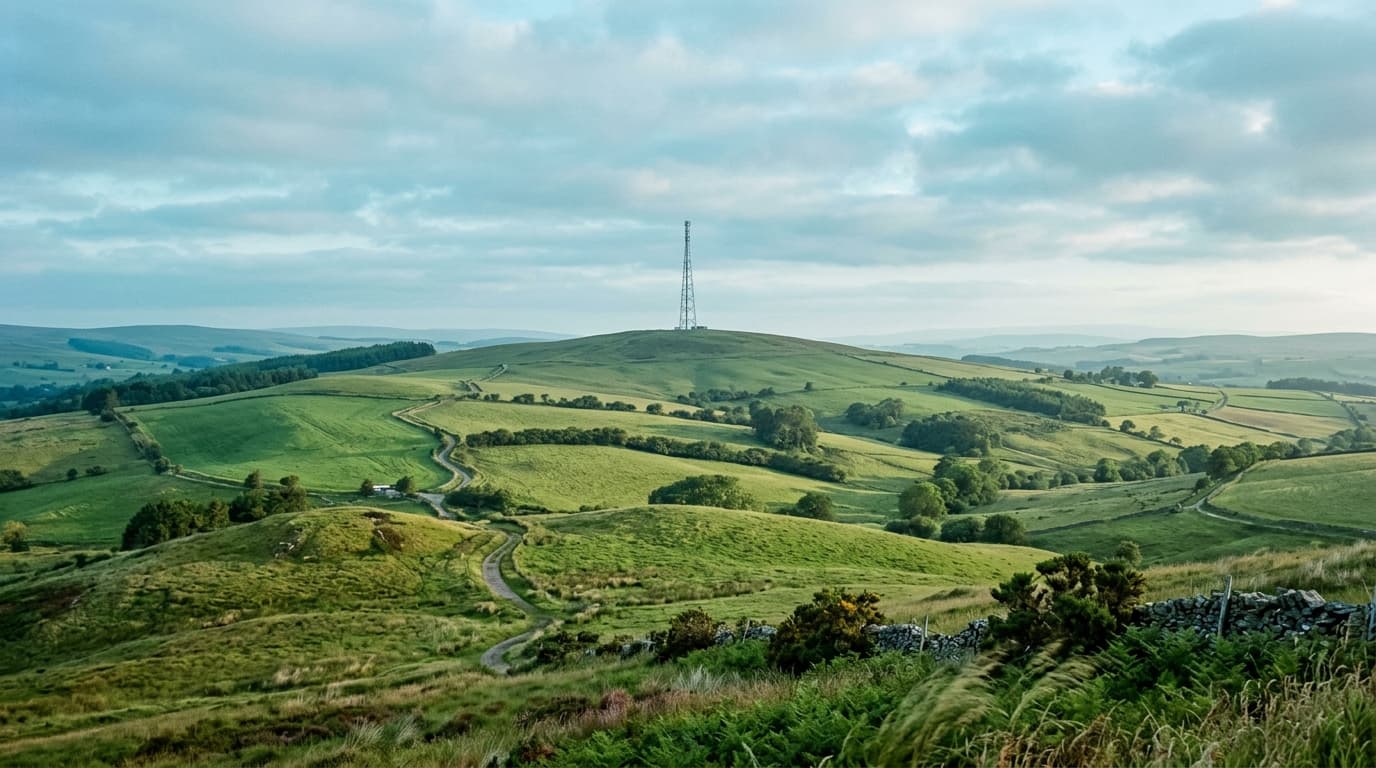
In Belgium, getting a signal in the countryside has little to do with the price of your plan: it all comes down to the network that covers your address. In 2026, Proximus remains the most complete in rural areas, Orange holds its own in the remote valleys of Wallonia, and Base trails by a notch. Here's how to decide based on your area, and what to do when the signal stays weak.
A rural area, in mobile network terms, is a low-density territory where antennas are spaced further apart: villages, hamlets, farmland plateaus and wooded valleys. Fewer antennas means coverage depends more on the operator and the terrain — and that's where the gap between Proximus, Orange, Base and DIGI really opens up.
Why is getting a signal harder in rural areas?
Because in the countryside, antennas are scarcer and the terrain blocks the signal. Where a city concentrates dozens of antennas per square kilometre, a farmland plateau or a wooded valley may have just one several kilometres away.
Three factors combine in rural areas. First, antenna density: fewer people, so fewer sites installed, and a signal that has to travel further. Second, terrain: in the Ardenne, the Famenne or the Condroz, steep valleys and forests absorb radio waves, creating grey zones even a few kilometres from an antenna. Third, indoor penetration: an old farmhouse with thick walls gets a weaker signal than a modern flat, a common problem in Belgian rural housing.
The concrete result: 4G covers about 99% of the Belgian population (Selectra, July 2026), but that figure is about population, not territory. In a sparsely inhabited valley, you may well be part of the remaining 1%. That's why rural coverage is judged by address, never on a national average.
Which operator gets the best signal in the Belgian countryside?
Proximus, in the vast majority of cases. Its network, inherited from the former incumbent, remains the densest in the country, including in rural areas. But Orange is right behind, and even ahead in some remote Walloon valleys.
Proximus owes its lead to seniority: it's the oldest and most tightly meshed network, which counts double in low-density areas. Its 4G reaches about 99% of the population and its 5G about 90% (Selectra, July 2026), and the operator is targeting 100% national coverage by the end of 2026. Orange shows even broader 4G on paper (about 99.9%) and excellent stability, but its 5G is more limited in the Ardennes. Base, backed by the Telenet network, is very solid in Flanders and a notch below in rural Wallonia.
Measured rural coverage: Proximus, Orange and Base in 2026
The 2026 measurements confirm a tight trio on 4G, with gaps widening on 5G and indoors. Here are the coverage figures recorded in July 2026, to be read as national ballpark numbers — your municipality may differ.
| Operator | 4G coverage | 5G coverage | In rural areas |
|---|---|---|---|
| Proximus | ~99% | ~90% | The most complete, densest network |
| Orange | ~99.9% | ~75-85% | Excellent 4G, strong in remote Wallonia |
| Base | ~97-98% | ~90% | Decent, better in Flanders |
| DIGI | rolling out | rolling out | Incomplete, relies on roaming |
Sources: Selectra (July 2026), IBPT reports 2024-2025. Indicative national figures; real coverage is checked at the address.
The lesson is clear: on 4G, the technology that carries the countryside, Proximus and Orange are neck and neck, while Base gives up some ground outside dense areas. 5G, meanwhile, stays mostly urban and Flemish in 2026: in rural Wallonia, it's the quality of 4G that shapes your daily life, not the presence of 5G.
Proximus or Orange: which one for rural Wallonia?
The two are within a few kilometres of each other, but Orange has a real edge in the remote valleys of Wallonia. In the Ardenne, the Famenne and the Condroz, Orange often shows the best 4G coverage, where Proximus dominates everywhere else.
This nuance comes from the rollout: Orange invested heavily to cover the low-density areas of the south, and its 4G there is known to be stable, even in valleys where the signal is temperamental. Proximus keeps the edge on overall density and blanket coverage, which makes it the safest default choice everywhere in Belgium. In practice, at a given address in the Belgian Luxembourg or in Fagne-Famenne, it's not rare for Orange to get a better signal than Proximus in a specific room of the house — hence the importance of testing at home.
The right move, if you're hesitating: ask a nearby neighbour which network they use and whether they get a good signal. In rural areas, coverage plays out at the hamlet level, sometimes the street. Local feedback beats a national map.
Does Base get a decent signal in rural areas?
Yes for everyday use, but with less of a safety margin than Proximus or Orange in deep rural Wallonia. Base relies on the Telenet network, rolled out first in Flanders then extended to Brussels and Wallonia. In rural Flanders, Base gets a strong signal; in the Ardenne valleys, its coverage is decent but a notch below the leading pair. For a tight budget at an address that isn't too isolated, Base remains a valid option — provided you check the signal at your place before committing.
Do DIGI and MVNOs get a good signal in the countryside?
DIGI is still risky in rural areas, while an MVNO gets exactly the same coverage as its host network. The difference is major: DIGI is still building its own network, whereas an MVNO rents an already mature one.
DIGI arrived in late 2024 as Belgium's fourth mobile operator, with its own network rolling out and roaming on an existing network in the meantime. In cities, the offer delivers on its low-price promise; in the countryside, its own coverage is still incomplete depending on the region. For rural use where the signal has to be reliable, DIGI is a gamble: unbeatable on price, but to be chosen only after checking coverage at your address.
Low-cost operators, for their part, don't build a network: they rent a major one. Scarlet, Mobile Vikings and Yoin run on Proximus; hey! relies on the Telenet (Base) network; Neibo on Orange. So a Scarlet plan in the countryside gets the same signal as a Proximus, sometimes with a speed capped at peak times. In short: for rural coverage, pick the right network for your area first, then the cheapest brand that runs on it.
What to do when the signal stays weak at your place?
Three solutions, from the simplest to the heaviest: Wi-Fi Calling, a signal booster and a 4G/5G Internet box. Each solves a different problem depending on whether you're short on calls or data.
Wi-Fi Calling (VoWiFi) is the first move, and the most effective. Offered at no extra cost by Proximus, Orange and Base, it routes your calls through your Internet box as soon as the mobile network is absent or weak. In a poorly covered but Internet-connected farmhouse, it transforms the experience: you call and receive normally, even without a signal bar. Turn it on in your phone's settings (the "Wi-Fi Calling" option).
If the issue is data around the house — in the garden, the barn, on the terrace — an approved signal booster (repeater) can pick up what little network is available and rebroadcast it. Be careful to use only a model compliant with IBPT rules, as a non-approved repeater is illegal. Finally, for home Internet where fixed lines (cable or VDSL) serve the area poorly, a 4G or 5G Internet box connected to the best mobile network in your area often makes a great replacement for a missing fixed line.
To go further, compare our head-to-head Proximus, Orange or Base: which gets the best signal and our analysis of 5G coverage operator by operator. For a broader choice, read our guide on which mobile operator to choose in Belgium.
Frequently asked questions
Maxime suit le marché télécom belge depuis dix ans. Il épluche les grilles tarifaires de Proximus, Orange, Telenet, VOO, BASE et des MVNO pour traduire le jargon (VDSL, câble, Easy Switch, 4play) en conseils utilisables.