Is fibre available at my address in Belgium?
Is fibre available at your home? How to test eligibility by address, who is rolling it out (Proximus, Telenet, Orange, VOO), and the fake-fibre trap in Belgium.
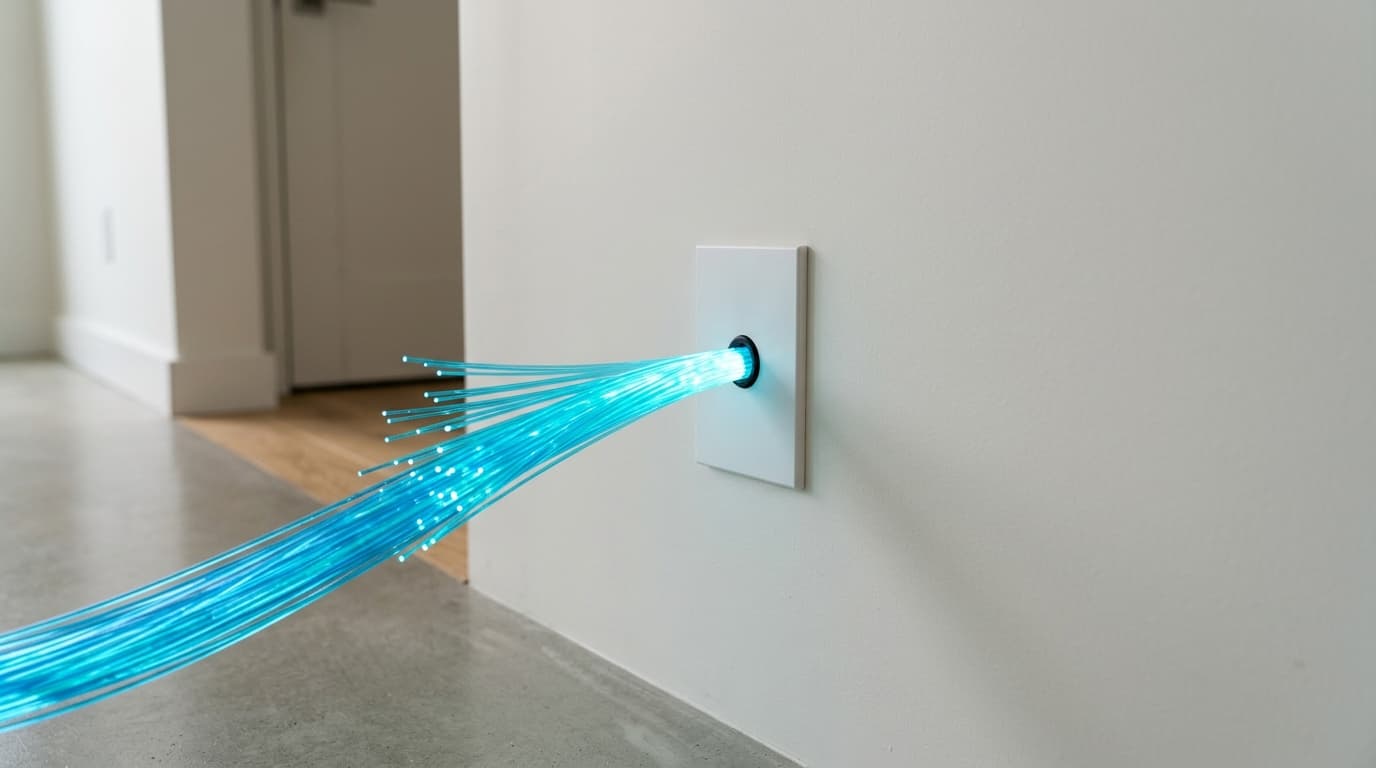
Fibre is not available everywhere in Belgium, and certainly not evenly: it arrives street by street, sometimes house number by house number. To know whether you qualify, there is only one reliable move: enter your exact address in an eligibility test. A regional map tells you nothing about your socket.
Fibre eligibility is the answer to a precise question: does fibre to the home (FTTH) already run to your address? It is not a matter of municipality or city, but of the physical connection built in front of your door. Until the cable is pulled down your street and into your home, fibre stays "planned", not available.
Is fibre available at my address?
The only reliable answer comes from a test at your exact address, not a coverage map. Fibre is rolled out in a very granular way, and two neighbours can get a different verdict depending on whether the trench has reached their number.
Deployment follows a construction logic: a street gets connected, then homes are activated one by one. As a result, there are cases where a building is eligible on the even side and not the odd, or where the ground floor is connected and the upper floor not yet. It is confusing, but that is the reality of a network built house by house.
Concretely, take two flats in the same Brussels building: one comes back as "fibre available", the other as "fibre being deployed, leave your email". Same roof, same street, different verdict. That is why no general map replaces the test at your address.
How do you test fibre eligibility in Belgium?
Enter your full address in an operator's tool or in the Atlas of the IBPT, the Belgian telecom regulator. Within seconds, you know whether fibre, cable or VDSL serves your home, and at what maximum speed.
Every major operator offers its own checker: Proximus, Telenet, Orange and VOO all display an "is fibre available at your home?" test on their site. They query the same infrastructure base, but only show their own offer. For a neutral view, the IBPT coverage Atlas lists the available networks independently of any sales pitch.
The right protocol has three steps: test your address with at least two operators, note the technology stated (FTTH, cable or VDSL) and the maximum speed, then compare prices only afterwards. Testing a single brand risks making you believe fibre does not exist at your home when a rival operator markets it on the same cable.
Which tools should you use to check your address?
Start with the operators' checkers (Proximus, Telenet, Orange, VOO) because they give the exact speed marketed to your socket. Then cross-check with the IBPT Atlas, which offers a public, independent map of fixed networks in Belgium, with no sales logic. Avoid relying solely on the "covered regions" maps in press articles: they date quickly and think in terms of cities, never addresses.
Fibre in my street: am I forced to take Proximus?
No. Proximus's fibre network is open, which means other operators can sell you a plan on exactly the same cables. You pick the operator for its price and service, not because it laid the fibre.
It is a regulatory principle: whoever deploys the infrastructure must rent access to competitors. Proximus confirms it itself — its fibre network is "fully open and any operator can benefit from it to offer its services". In practice, Orange, Scarlet and EDPnet market fibre plans that run on the network built by Proximus or its affiliates.
Take a concrete case: fibre reaches your street, laid by the Proximus works. You can subscribe with Proximus, but also with Orange, whose Home Fiber offer starts around 51 EUR/month for a comparable speed. Same physical cable, different bill. The only thing to check is that the operator you want actually markets fibre at your precise address, because they do not all activate everywhere at the same pace.
Proximus, Telenet, Orange, VOO: who is rolling out fibre and where?
Deployment is shared between a few players, with a very marked geography: Flanders and the big cities move fast, rural Wallonia lags. Here is who builds what and on which network operators resell.
Proximus is the main FTTH builder, through its affiliates and the acquisition of Unifiber, targeting 95% national coverage by 2032 and 100% in Brussels aimed for 2026. In Flanders, Wyre (Telenet's network builder) and Fiberklaar (a Proximus affiliate) got the green light from the Belgian Competition Authority to cooperate: over two million homes must become connectable, mostly by 2029, the rest by 2037. DIGI, which arrived in late 2024, lays its own network and slashes prices. VOO, for its part, bets mostly on its upgraded coaxial cable rather than on massive FTTH.
| Network / player | Technology deployed | Where | Operators selling on it |
|---|---|---|---|
| Proximus / Fiberklaar / Unifiber | FTTH fibre | Brussels, big cities, 200+ municipalities | Proximus, Orange, Scarlet, EDPnet |
| Wyre (Telenet) | FTTH fibre + cable | Flanders | Telenet, third-party operators |
| VOO | Coaxial cable (DOCSIS), "GIGA" | Wallonia, Brussels | VOO |
| DIGI | Own FTTH fibre | Areas under rollout | DIGI |
Sources: Proximus (fibre deployment, open network), Telenet press release (Wyre-Fiberklaar deal), Test-Achats (fibre dossier, Unifiber acquisition), WebSearch July 2026.
"Fibre" or real FTTH: where is the trap?
The trap is the word "fibre" stuck onto an offer that is not fibre to the home. Several gigabit products actually run over coaxial cable on the last stretch. The speed is good, but the technology is not the same.
Real fibre is FTTH: the optical fibre goes all the way to a socket in your home. Coaxial cable, by contrast, brings fibre to a point in the neighbourhood, then finishes in coax (DOCSIS technology) to your home. That is the case with VOO's GIGA, marketed under the "fibre" banner while it runs on the legacy cable network. It is not a scam, but if you want pure FTTH, read the spec sheet, not the slogan.
Put plainly: when subscribing, look for the wording "FTTH" or "fibre to the home". If the offer says "fibre" without specifying and your home is served by cable, there is a strong chance it is DOCSIS. For everyday use, the difference is small; for heavy regular uploads, it matters.
Is VOO's fibre a real fibre?
Not strictly. VOO's GIGA offers gigabit speeds, but over the coaxial cable network, not FTTH to your socket. VOO deploys fibre in its core network and brings fibre closer to homes, but the last metre often stays coax. Concretely, you will get very good download speeds; upload and peak-hour stability remain the points where true FTTH keeps the edge.
What should you do if fibre is not available at your home yet?
Fall back on cable or VDSL, which serve the vast majority of Belgian addresses and cover almost all uses. Then watch the rollout, because the map moves fast in areas under construction.
Coaxial cable (VOO in Wallonia and Brussels, Telenet in Flanders) often reaches gigabit downstream: for 4K streaming, video calls and remote work, you will not see the difference from fibre day to day. VDSL, older and dependent on the distance to the exchange, caps lower (often 50 to 100 Mbps) and suits moderate use. The real handicap of waiting for fibre is being stuck on sluggish VDSL when a gigabit cable may already be available at your address.
The right reflex: rerun an eligibility test every six months if your area is announced as under deployment. I have seen addresses go from "nothing planned" to "fibre available" in under a year in municipalities with active works. Leaving your email with the operator to be notified of activation saves you checking blindly.
How long before fibre reaches my street?
No one can give you a firm date per address until the works are planned in your street. The known milestones give the order of magnitude: in Flanders, the Wyre-Fiberklaar deal targets over two million connectable homes by 2029, the rest by 2037; Proximus aims for 95% of the country by 2032. Rural Wallonia is the area furthest behind, and some streets there will not see fibre for several years. In the meantime, cable remains the best bridge to gigabit.
Is fibre worth it if cable is enough for me?
If your gigabit cable holds up, fibre is not urgent: it mostly adds headroom, not a visible revolution. It becomes worthwhile when you saturate, when you upload a lot, or when the neighbourhood cable slows down in the evening.
Three concrete advantages separate FTTH from a good cable: a higher, symmetrical upload speed with some operators (useful for sending big files, backing up online or hosting), slightly lower latency, and no shared congestion. Coaxial cable pools a neighbourhood's capacity: at peak hours, between 8pm and 11pm, speed can drop when all the neighbours stream at once. Dedicated fibre does not suffer this.
For a household that browses, watches Netflix and does video calls, a 500 Mbps or 1 Gbps cable is more than enough, and switching to full-price fibre makes no immediate sense. For a remote worker sending big files, a latency-sensitive gamer, or a family running four 4K screens in the evening, fibre earns its price. The right calculation is your real usage, not the biggest number on the brochure.
To go further, understand why your address decides between cable and VDSL, compare the brands in our guide to the best internet provider in Belgium, and if budget comes first, see which is the cheapest internet before committing to fibre.
Frequently asked questions
Maxime suit le marché télécom belge depuis dix ans. Il épluche les grilles tarifaires de Proximus, Orange, Telenet, VOO, BASE et des MVNO pour traduire le jargon (VDSL, câble, Easy Switch, 4play) en conseils utilisables.