14-day cooling-off period: cancelling a telecom contract
Signed online, you get 14 days to cancel a Belgian telecom contract. Signed in a shop, none. The cases, the deadlines, the pro-rata you owe.
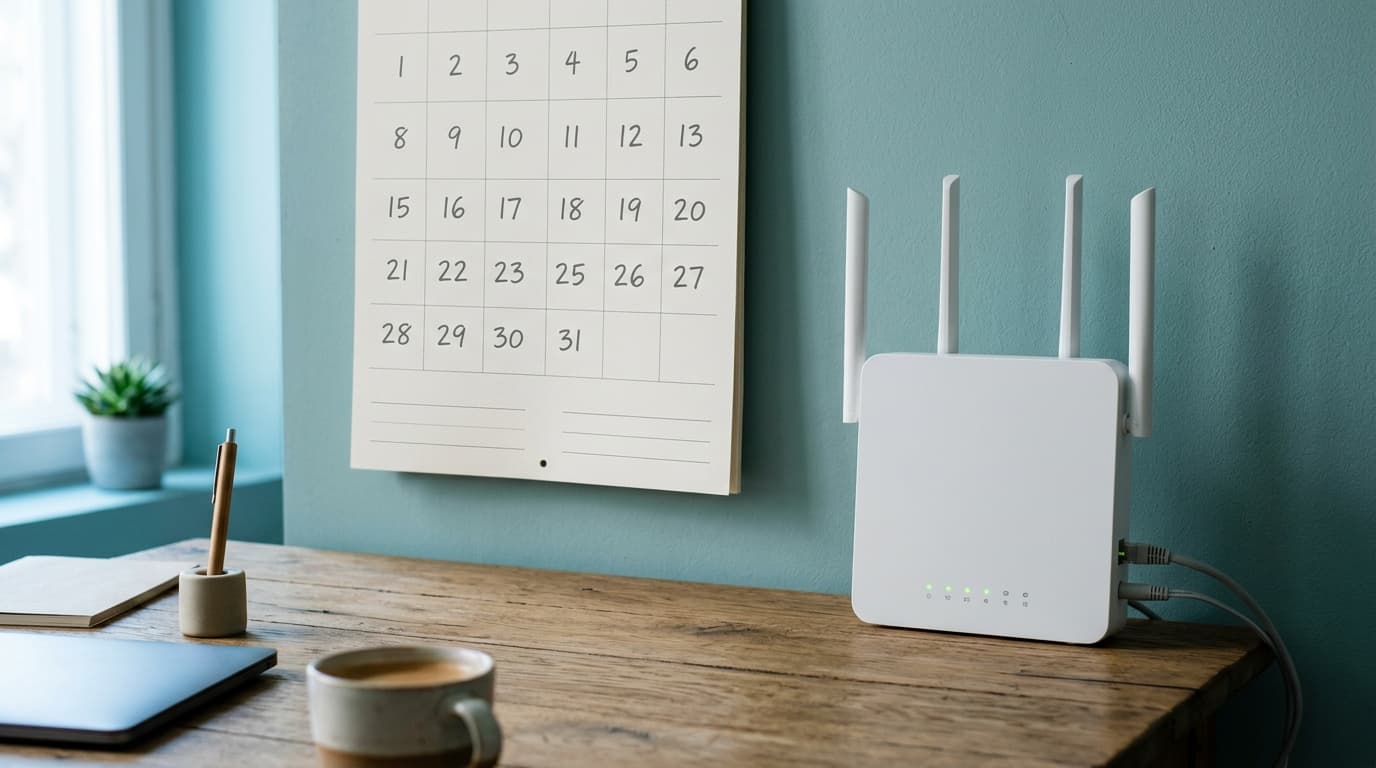
Not always, no. You get 14 days to cancel a Belgian telecom contract signed online, over the phone or on your doorstep. Signed at a shop counter, that deadline does not exist. The difference has nothing to do with the operator: it comes down to where you put your signature.
The right of withdrawal is the ability to cancel a contract without giving a reason and without paying a penalty, within a period fixed by law. In Belgium it runs for 14 calendar days and sits in article VI.47 of the Code of Economic Law, summarised by the FPS Economy. It is not the same thing as termination, which ends a contract already running.
Do you really get 14 days to cancel?
One criterion decides it: the law only protects contracts concluded at a distance or off-premises. A contract signed inside a shop, facing a salesperson, fits neither box.
| Where and how you signed | 14-day period | The clock starts |
|---|---|---|
| At the counter of an operator shop | No | No period at all |
| On the operator website or app | Yes | The day of the order |
| By phone, whether you called or they did | Yes | The day the deal was confirmed |
| At home, doorstep selling | Yes | The day of signature |
| On a temporary stand, trade fair or mall | In principle yes | The day of signature |
| Handset or set-top box shipped with the contract | Yes | The day the parcel arrives |
The arguable line is the trade fair stand. The Court of Justice of the European Union has held that a stand run by a trader on a habitual basis can count as business premises, which would remove the deadline. A Belgian operator refusing withdrawal on that ground would have to prove it, and few try.
A contract signed in a shop opens no deadline
No salesperson lies about this: they simply say nothing. You walk out with a 24-month contract, a set-top box under your arm, and no right to change your mind. The first point at which Belgian law lets you go without a euro of penalty is the seventh month.
14 calendar days: two clocks in the same contract?
Calendar days, not working days. Weekends and public holidays count, and if day fourteen falls on a Sunday the deadline slides to the next working day.
Bundles are where it gets messy. An internet + TV + mobile contract signed online runs two clocks at once: the service starts its countdown on the day of the order, while every device shipped starts its own on the day the parcel arrives. A free handset received nine days after signature therefore still leaves two weeks to send it back, at a point when the deadline on the subscription itself is nearly spent. Two different dates inside a single contract, and that is where most of the misunderstandings come from.
Write both dates down on signature day. Not later.
How do you withdraw, step by step?
- Put it in writing. An email will do, a registered letter is better. The standard withdrawal form published by the FPS Economy removes any argument about what you actually asked for.
- Date it and keep the proof. Delivery receipt, screenshot of the send, registered-letter number. Proving the request went out, and when, is on you.
- Cancel the engineer appointment. At Proximus you can change it online through the link in the confirmation email, but cancelling it goes through the phone line 0800 33 800 only. A detail that hurts on a Friday evening.
- Send the hardware back within 14 days of your request, complete, with proof of postage.
- Check the refund. The operator has 14 days from receiving your withdrawal to refund you.
Five mistakes that cost you the deadline
- Signing in a shop while assuming the website rules apply.
- Ticking the immediate-execution box without reading what it carries.
- Calling the operator and leaving no written trace at all.
- Returning the modem with no proof of postage, then finding it billed.
- Letting Easy Switch kill the old contract before you have decided.
What do you pay if the installation already happened?
The pro-rata share of the service used, and in principle nothing else.
When you tick the box marked "I request immediate execution", you are not giving up your right: you are agreeing to pay for whatever gets supplied if you leave. The Code of Economic Law speaks of an amount proportionate to the service already provided, calculated on the total contract price.
So let us do the sums. A Scarlet Loco plan at 34 EUR/month, recorded on 2 September 2026, activated on the day of the order and cancelled on day twelve: 12/30 × 34, or 13.60 EUR. Over that same window the running promotion drops the activation fee to 0 EUR, which caps the whole exposure at those 13.60 EUR. Outside the promotion, the same hesitation costs 29 EUR of activation on top, and 79 EUR if an engineer came out at your request.
Hardware goes back. Modem, set-top box, self-install kit: lent, never given. Unreturned, they reappear on the closing invoice at list price.
How much do activation and installation cost, and how long do they take?
| Operator (host network) | Activation | Installation | Quoted lead time |
|---|---|---|---|
| Scarlet (resells the Proximus network) | 29 EUR, dropped to 0 EUR on a web promotion until 01/11/2026 on Loco | 0 EUR self-install, 79 EUR for an optional engineer, 0 EUR where self-install is impossible at the address | Kit shipped in 2 to 3 working days, engineer within about 10 working days |
| Proximus (its own copper and fibre networks) | Included | 0 EUR on a Flex+ Mega, Giga or Ultra Fiber bundle, 59 EUR on a standalone Internet Fiber | Two to four hours on site, by appointment |
Recorded on 2 September 2026 on the official pages of Scarlet and Proximus.
Now lay the two calendars on top of each other. An order placed on Wednesday 2 September leaves you until 16 September to withdraw. Ten working days counted from 3 September land on exactly 16 September. The quoted engineer visit therefore arrives on the last day of the deadline, when there is nothing left to decide. The self-install kit, meanwhile, arrives on the third working day, comfortably inside the window.
Put plainly: to test before deciding, take the self-install option. The engineer makes you choose blind.
At Telenet, which runs its own cable network in Flanders and Brussels, at Orange, which sells the Walloon cable network since absorbing VOO, or at DIGI, which arrived with its own mobile network and its own fibre, the amounts and lead times differ. The reasoning does not: compare the date of the first intervention with the date your deadline expires. Your address changes everything, and our guide to fibre availability at your address explains why two neighbours are not offered the same deals.
Easy Switch started, and the old contract does not come back
Here is the trap, and it is structural. When you sign up with a new operator and hand over your Easy Switch code, that operator triggers the termination of your old contract, often within days. Withdraw afterwards and your withdrawal cancels the new contract. It does not revive the old one. You end up with no operator, a sign-up to redo and number portability to restart. Our piece on Easy Switch and service downtime covers the procedure: ask the new operator to hold the switch until after day fourteen.
Self-employed or small company: do you get the same 14 days?
No on withdrawal, yes on a good deal of the rest.
The right of withdrawal is reserved to consumers, meaning people signing up for private purposes. A contract in a company name is excluded, even signed online. Belgian telecom law goes further, though: according to the BIPT, the Belgian telecoms regulator, a micro-enterprise of at most nine employees keeps several consumer protections by default, including the 24-month cap on contract length, unless it expressly and freely waives them at signature. Read that clause before initialling it.
Before signing anything, compare post-promotion pricing in our internet provider ranking, and check whether the bundle you want exists without a commitment.
Frequently asked questions
Maxime suit le marché télécom belge depuis dix ans. Il épluche les grilles tarifaires de Proximus, Orange, Telenet, VOO, BASE et des MVNO pour traduire le jargon (VDSL, câble, Easy Switch, 4play) en conseils utilisables.